PDF · English
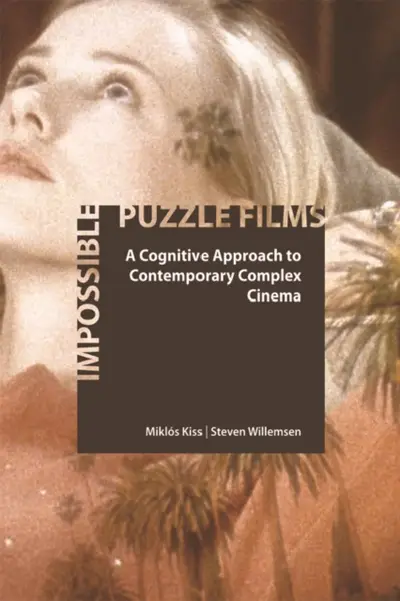
Impossible Puzzle Films
A Cognitive Approach to Contemporary Complex Cinema
Price and availability
$35.99
Available in: Andorra, Austria, Australia, Belgium, Bulgaria, Canada, Switzerland, Cyprus, Czechia, Germany, Denmark, Estonia, Spain, Finland, France, United Kingdom, Guernsey, Greece, Croatia, Hungary, Ireland, Isle of Man, Iceland, Italy, Jersey, Japan, Liechtenstein, Lithuania, Luxembourg, Latvia, Monaco, Malta, Netherlands, Norway, Poland, Portugal, Romania, Sweden, Slovenia, Slovakia, San Marino, United States, Vatican City, South Africa
Stores: US, UK, Canada, EU, Australia.
Sign in to buyThe price is re-checked by the server before payment.
For personal use under the eBook licence.
- Format
- DRM
- Not stated by the publisher
- Language
- English
- Publisher
- Edinburgh University Press
- Published
- 18 January 2017
- Pages
- 240
- ISBN
- 9781474406741
- Subjects
- Films, cinema, Film theory & criticism, Individual film directors, film-makers, Film: styles & genres, Cognition & cognitive psychology, Films, cinema, Film history, theory or criticism, Individual film directors, film-makers, Film: styles and genres, Cognition and cognitive psychology
About this book
Narrative complexity is a trend in contemporary cinema. Since the late 1990s there has been a palpable increase in complex storytelling in movies. But how and why do complex movies create perplexity and confusion? How do we engage with these challenges? And what makes complex stories so attractive? By blending film studies, narrative theory and cognitive sciences, Kiss and Wilemsen look into the relation between complex storytelling and the mind. Analysing the effects that different complex narratives have on viewers, the book addresses how films like Donnie Darko, Mulholland Drive and Primer strategically create complexity and confusion, using the specific category of the impossible puzzle film to examine movies that use baffling paradoxes, impossible loops, and unresolved ambiguities in their stories and storytelling. By looking at how these films play on our mind's blind spots, this innovative book explains their viewing effects in terms of the mental state of cognitive dissonance that they evoke.
Bibliographic data © Gardners Books Ltd.