PDF · English
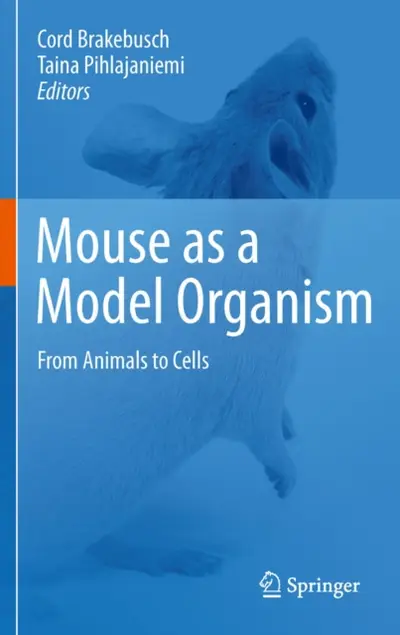
Mouse as a Model Organism
From Animals to Cells
Price and availability
$175.99
Available in: Andorra, Austria, Australia, Belgium, Bulgaria, Canada, Switzerland, Cyprus, Czechia, Germany, Denmark, Estonia, Spain, Finland, France, United Kingdom, Guernsey, Greece, Croatia, Hungary, Ireland, Isle of Man, Iceland, Italy, Jersey, Japan, Liechtenstein, Lithuania, Luxembourg, Latvia, Monaco, Malta, Netherlands, Norway, Poland, Portugal, Romania, Sweden, Slovenia, Slovakia, San Marino, United States, Vatican City, South Africa
Stores: US, UK, Canada, EU, Australia.
Sign in to buyThe price is re-checked by the server before payment.
For personal use under the eBook licence.
- Format
- DRM
- Not stated by the publisher
- Language
- English
- Publisher
- Springer Netherlands
- Published
- 29 March 2011
- ISBN
- 9789400707504
- Subjects
- Medical research, Science: general issues, Scientific equipment, experiments & techniques, Biology, life sciences, Genetics (non-medical), Medical research, Scientific equipment, experiments and techniques, Biology, life sciences, Genetics (non-medical)
About this book
Cell culture based research is important for our understanding of biological processes at the cellular and molecular level. Using this approach, the previous decades have produced a wealth of mechanistic information in all areas of biomedical research. Such in vitro research, however, lacks the complexity of in vivo investigations, where many different cell types interact with each other in a normal, three-dimensional environment, with normal levels of cytokines and growth factors. Furthermore, complex human diseases, such as cancer, diabetes or chronic inflammation, can only be modeled in vivo. Due to its small size, its short reproduction time, and the possibility to introduce specific gene mutations, the mouse has become the favourite mammalian model organism to study in vivo function of genes during development and in disease. This book combines review articles on selected subjects presented at the symposium "e;Mouse as a Model Organism - From Animals to Cells"e;, held in Rovaniemi, Finland, 2009. Among other topics, high-throughput phenotyping of mouse mutants, mouse phenotypes dependent on nature and nuture, and a spectrum of in vivo, ex vivo and in vitro methods to study cancer in mice are described. This book will give an excellent introduction to scientists interested in the use of mice as a model to understand complex biological questions in the post-genomic era. It will highlight the possibilities, but also discuss the current problems and shortcomings, to give a realistic view of the current state-of-art in this fascinating field of biomedical research.
Bibliographic data © Gardners Books Ltd.