PDF · English
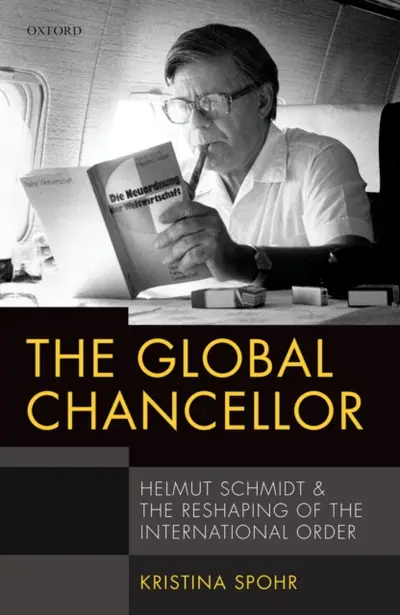
Global Chancellor
Helmut Schmidt and the Reshaping of the International Order
Price and availability
$54.99
Available in: Andorra, Austria, Australia, Belgium, Bulgaria, Canada, Switzerland, Cyprus, Czechia, Germany, Denmark, Estonia, Spain, Finland, France, United Kingdom, Guernsey, Greece, Croatia, Hungary, Ireland, Isle of Man, Iceland, Italy, Jersey, Japan, Liechtenstein, Lithuania, Luxembourg, Latvia, Monaco, Malta, Netherlands, Norway, Poland, Portugal, Romania, Sweden, Slovenia, Slovakia, San Marino, United States, Vatican City, South Africa
Stores: US, UK, Canada, EU, Australia.
Sign in to buyThe price is re-checked by the server before payment.
For personal use under the eBook licence.
- Format
- DRM
- Not stated by the publisher
- Language
- English
- Publisher
- Oxford University Press
- Published
- 24 March 2016
- ISBN
- 9780191064913
- Subjects
- Germany, c 1970 to c 1980, c 1980 to c 1990, European history, Postwar 20th century history, from c 1945 to c 2000, The Cold War, Political leaders & leadership, International relations, Economic history, Political leaders and leadership, International relations, Economic history, European history, Cold wars and proxy conflicts
About this book
Helmut Schmidt is the neglected chancellor of modern German history, overshadowed by 'the greats' - Bismarck, Adenauer, Brandt and Kohl. This volume retrieves Schmidt's true significance as a pivotal figure who helped reshape the global order during the crisis-ridden 1970s. This major reinterpretation, based on detailed research in Schmidt's private papers and numerous archives in Europe and America, reveals him as a leader equally skilled in economics and security, and adept at personal diplomacy, who dared to act as a 'double interpreter' between the superpowers during the nadir of the Cold War. Schmidt was no mere 'crisis-manager': in fact he brought to the chancellorship a depth of reflection, evident in two decades of writings and speeches that justifies considering him an intellectual statesman on a par with Henry Kissinger. His achievements were prodigious. Hailed as the 'world economist', Schmidt helped create the G7 forum for global economic governance and the European Monetary System at a time when capitalism seemed on the rocks. And as the 'strategist of balance', he designed NATO's 'dual-track' response to the crisis caused by the massive Soviet arms buildup of Euro-missiles. This decision, Kristina Spohr argues, played a crucial part in holding together the Western alliance and paved the way to defusing the Cold War in Europe. Schmidt brought his country to the top table of world politics - what he unashamedly called Weltpolitik - as an equal of the wartime victor powers. It was through his Chancellorship that West Germany came of age on the global stage.
Bibliographic data © Gardners Books Ltd.