EPUB · English
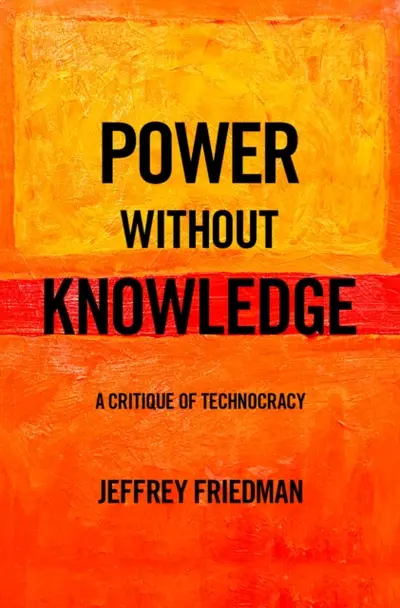
Power without Knowledge
A Critique of Technocracy
Price and availability
$41.99
Available in: Andorra, Austria, Australia, Belgium, Bulgaria, Canada, Switzerland, Cyprus, Czechia, Germany, Denmark, Estonia, Spain, Finland, France, United Kingdom, Guernsey, Greece, Croatia, Hungary, Ireland, Isle of Man, Iceland, Italy, Jersey, Japan, Liechtenstein, Lithuania, Luxembourg, Latvia, Monaco, Malta, Netherlands, Norway, Poland, Portugal, Romania, Sweden, Slovenia, Slovakia, San Marino, United States, Vatican City, South Africa
Stores: US, UK, Canada, EU, Australia.
Sign in to buyThe price is re-checked by the server before payment.
For personal use under the eBook licence.
- Format
- EPUB
- DRM
- Not stated by the publisher
- Language
- English
- Publisher
- Oxford University Press
- Published
- 16 December 2019
- ISBN
- 9780190877194
- Subjects
- Social & political philosophy, Political science & theory, Political structure & processes, Political science and theory, Political structure and processes, QDTS
About this book
Technocrats claim to know how to solve the social and economic problems of complex modern societies. But as Jeffrey Friedman argues in Power without Knowledge, there is a fundamental flaw with technocracy: it requires an ability to predict how the people whom technocrats attempt to control will act in response to technocratic policies. However, the mass public's ideas-the ideas that drive their actions-are far too varied and diverse to be reliably predicted. But that is not the only problem. Friedman reminds us that a large part of contemporary mass politics, even populist mass politics, is essentially technocratic too. Members of the general public often assume that they are competent to decide which policies or politicians will be able to solve social and economic problems. Yet these ordinary "e;citizen-technocrats"e; typically regard the solutions to social problems as self-evident, such that politics becomes a matter of vetting public officials for their good intentions and strong wills, not their technocratic expertise. Finally, Friedman argues that technocratic experts themselves drastically oversimplify technocratic realities. Economists, for example, theorize that people respond rationally to the incentives they face. This theory is simplistic, but it gives the appearance of being able to predict people's behavior in response to technocratic policy initiatives. If stripped of such gross oversimplications, though, technocrats themselves would be forced to admit that a rational technocracy is nothing more than an impossible dream. Ranging widely over the philosophy of social science, rational choice theory, and empirical political science, Power without Knowledge is a pathbreaking work that upends traditional assumptions about technocracy and politics, forcing us to rethink our assumptions about the legitimacy of modern governance.
Bibliographic data © Gardners Books Ltd.