EPUB · English
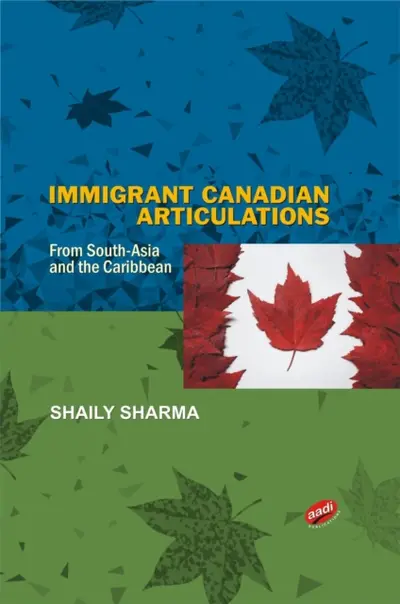
Immigrant Canadian Articlulations
From South-Asia and the Caribbean
Price and availability
$40.99
Available in: Andorra, Austria, Australia, Belgium, Bulgaria, Canada, Switzerland, Cyprus, Czechia, Germany, Denmark, Estonia, Spain, Finland, France, United Kingdom, Guernsey, Greece, Croatia, Hungary, Ireland, Isle of Man, Iceland, Italy, Jersey, Japan, Liechtenstein, Lithuania, Luxembourg, Latvia, Monaco, Malta, Netherlands, Norway, Poland, Portugal, Romania, Sweden, Slovenia, Slovakia, San Marino, United States, Vatican City, South Africa
Stores: US, UK, Canada, EU, Australia.
Sign in to buyThe price is re-checked by the server before payment.
For personal use under the eBook licence.
- Format
- EPUB
- DRM
- Not stated by the publisher
- Language
- English
- Publisher
- Aadi Publications
- Published
- 30 June 2012
- Pages
- 189
- ISBN
- 9789385484315
- Subjects
- Anthologies (non-poetry), DNT
About this book
Immigrant Canadian Articulations provides an analysis of the theoretical, critical and fictional works of South Asian and the Caribbean immigrant writers in Canada, and discusses their representativeness as writers of Canadian literature. Through the study of minority writing in Canada, Shaily Sharma portrays a dialogue between immigrant writers and the Canadian nation state within its multicultural framework. She argues that the Canadian multicultural act might serve as a powerful weapon with the potential to accord social equality and liberty to all members of the society; it is still held responsible for ethnic exclusivity and commodification. The individual essays provide theoretical background to the development of Canadian nation and its integral aspect, i,e. multiculturalism, as well as fictional works affected and effected by the politics of identity, belongingness, and memories of homeland. Authors discussed include Neil Bissoondath, Rama Bai Espinet, Arun Prabha Mukherjee, Himani Bannerji, Rohinton Mistry, and Anita Rau Badami. The essays are fruther substantiated by the theoretical formulations of Homi Bhabha, Gayatri Spivak, Edward Said, and Lynette Hunter
Bibliographic data © Gardners Books Ltd.