PDF · English
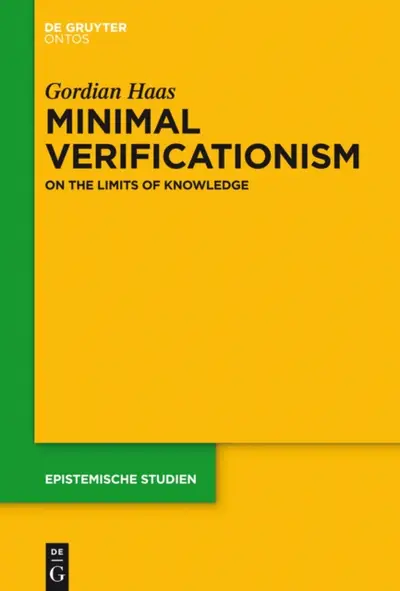
Minimal Verificationism
On the Limits of Knowledge
Price and availability
$143.99
Available in: Andorra, Austria, Australia, Belgium, Bulgaria, Canada, Switzerland, Cyprus, Czechia, Germany, Denmark, Estonia, Spain, Finland, France, United Kingdom, Guernsey, Greece, Croatia, Hungary, Ireland, Isle of Man, Iceland, Italy, Jersey, Japan, Liechtenstein, Lithuania, Luxembourg, Latvia, Monaco, Malta, Netherlands, Norway, Poland, Portugal, Romania, Sweden, Slovenia, Slovakia, San Marino, United States, Vatican City, South Africa
Stores: US, UK, Canada, EU, Australia.
Sign in to buyThe price is re-checked by the server before payment.
For personal use under the eBook licence.
- Format
- DRM
- Not stated by the publisher
- Language
- English
- Publisher
- De Gruyter
- Published
- 16 October 2015
- ISBN
- 9781501501982
- Subjects
- Western philosophy: Enlightenment, Philosophy: epistemology & theory of knowledge, Interdisciplinary studies, Western philosophy: Enlightenment, Philosophy: epistemology and theory of knowledge, Philosophy: logic
About this book
Verificationism has been a hallmark of logical empiricism. According to this principle, a sentence is insignificant in a certain sense if its truth value cannot be determined. Although logical empiricists strove for decades to develop an adequate principle of verification, they failed to resolve its problems. This led to a general abandonment of the verificationist project in the early 1960s. In the last 50 years, this view has received tremendously bad press. Today it is mostly regarded as an outdated historical concept. Theories that have evolved since the abandonment of verificationism can, however, help overcome some of its key problems. More specifically, an adequate criterion of significance can be derived from a combination of modern theories of justification and belief revision, along with a formal semantics for counterfactuals. In view of these potential improvements, the abandonment of verificationism appears premature. Half a century following its decline, it might be about time to revisit this disreputable view. The author argues in favor of a weak form of verificationism. This approach could be referred to as minimal verificationism, as it involves a weakening of traditional verificationist principles in various respects while maintaining their core idea.
Bibliographic data © Gardners Books Ltd.