EPUB · English
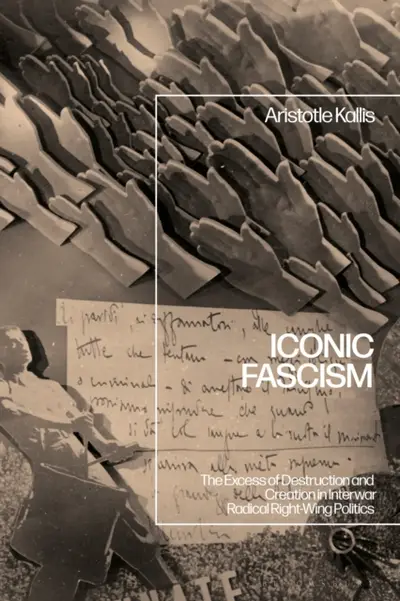
Iconic Fascism
The Excess of Destruction and Creation in Interwar Radical Right-Wing Politics
Price and availability
$103.99
Available in: Andorra, Austria, Australia, Belgium, Bulgaria, Canada, Switzerland, Cyprus, Czechia, Germany, Denmark, Estonia, Spain, Finland, France, United Kingdom, Guernsey, Greece, Croatia, Hungary, Ireland, Isle of Man, Iceland, Italy, Jersey, Japan, Liechtenstein, Lithuania, Luxembourg, Latvia, Monaco, Malta, Netherlands, Norway, Poland, Portugal, Romania, Sweden, Slovenia, Slovakia, San Marino, United States, Vatican City, South Africa
Stores: US, UK, Canada, EU, Australia.
Sign in to buyThe price is re-checked by the server before payment.
For personal use under the eBook licence.
- Format
- EPUB
- DRM
- Not stated by the publisher
- Language
- English
- Publisher
- Bloomsbury Publishing
- Published
- 19 February 2026
- Pages
- 256
- ISBN
- 9781350169098
- Subjects
- Western Continental Europe, 20th century, European history, 20th century history: c 1900 to c 2000, Fascism & Nazism, 3MP, Far-right political ideologies and movements, NH, NHD
About this book
In Iconic Fascism, Aristotle Kallis uncovers the paradox at the heart of fascist politics: the simultaneous obsession with destroying and creating powerful symbols. This book demonstrates how fascists were simultaneously some of history's most passionate icon-lovers and most ruthless icon-breakers, wielding symbolic excess as both weapon and worship in their revolutionary project. Through a sweeping comparative analysis, Kallis reveals how fascist movements and later regimes were driven by a relentless battle of absolutes, seeking not only to eradicate the icons and reclaim the spaces of their enemies, but to saturate public life with their own emblems, rituals, and myths; and to make the political visceral. Kallis demonstrates that fascist violence was never merely blind or indiscriminate. Instead, it was a meticulously choreographed struggle for symbolic dominance, in which the destruction of enemy 'false' icons was inseparable from the performative creation of new, sacred icons of fascist power. He traces how this constant pursuit of "e;destructive creation"e; evolved from street-level partisan warfare to state-sponsored spectacles of monumental architecture and mass liturgies. Kallis argues that fascism's 'iconic compulsion' - its need to condense moral absolutes into visible, emotionally potent symbols - remained constant whether fascists operated as fringe insurgents or totalitarian regimes, fuelling its cycles of rupture and rebirth. Spanning street-level violence, mass spectacle, and monumental urban planning, Iconic Fascism challenges us to rethink the role of symbols in the making-and unmaking-of political communities.
Bibliographic data © Gardners Books Ltd.