EPUB · English
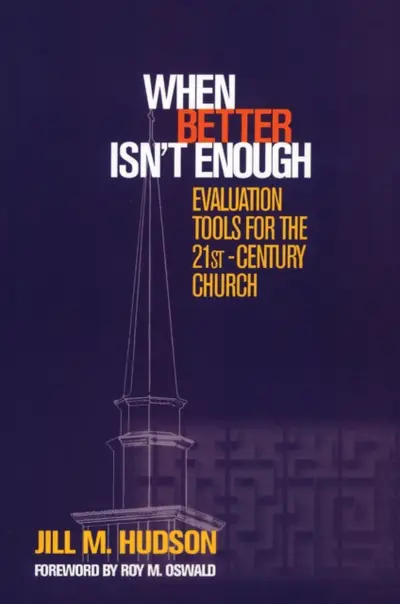
When Better Isn't Enough
Evaluation Tools for the 21st-Century Church
Price and availability
$26.99
Available in: Andorra, Austria, Australia, Belgium, Bulgaria, Canada, Switzerland, Cyprus, Czechia, Germany, Denmark, Estonia, Spain, Finland, France, United Kingdom, Guernsey, Greece, Croatia, Hungary, Ireland, Isle of Man, Iceland, Italy, Jersey, Japan, Liechtenstein, Lithuania, Luxembourg, Latvia, Monaco, Malta, Netherlands, Norway, Poland, Portugal, Romania, Sweden, Slovenia, Slovakia, San Marino, United States, Vatican City, South Africa
Stores: US, UK, Canada, EU, Australia.
Sign in to buyThe price is re-checked by the server before payment.
For personal use under the eBook licence.
- Format
- EPUB
- DRM
- Not stated by the publisher
- Language
- English
- Publisher
- Bloomsbury Publishing (USA)
- Published
- 1 February 2004
- Pages
- 170
- ISBN
- 9781566996952
- Subjects
- Christian Churches & denominations, Religious institutions & organizations, QRMB, QRVS
About this book
Many sociologists and a growing number of church scholars have noted that we live in a time of transition-from the modern era to the postmodern. Whenever a shift of this magnitude occurs, it leaves all of life, including the church, in flux. We instinctively strive to stabilize the situation by re-establishing what has worked in the past. Increasingly, however, congregations are finding that the same old things done harder or better don't seem to make a difference. Author Jill Hudson argues, "e;We must identify new criteria for success, and perhaps even for faithfulness, and hold ourselves accountable to them."e; Approaching the postmodern era as a tremendous opportunity, Hudson identifies 12 characteristics by which we can measure effective ministry for the early 21st century. Based on those 12 criteria, Hudson has created evaluation tools, "e;an early measuring stick,"e; to help congregations evaluate their work in this new era. Not everything of the past is ineffective and best discarded, she says, nor will everything we try in the future be successful. But by faithfully listening for God's guidance and carefully evaluating progress using Hudson's tools, looking at the ministry of the whole people of God as well as that of the professional staff, congregations can improve their ministry, help members and staff grow in effectiveness, deepen a sense of partnership, and add new richness to the dialogue about the congregation's future.
Bibliographic data © Gardners Books Ltd.