PDF · English
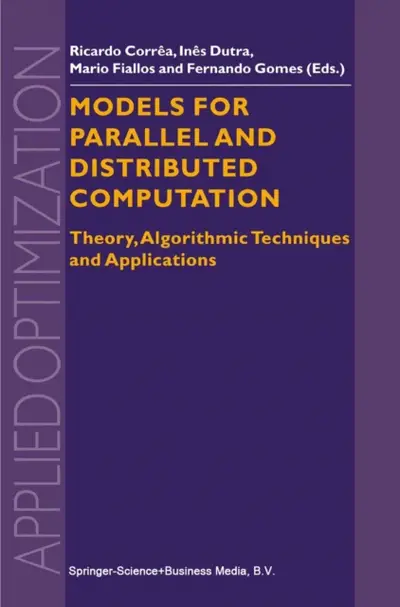
Models for Parallel and Distributed Computation
Theory, Algorithmic Techniques and Applications
Price and availability
$175.99
Available in: Andorra, Austria, Australia, Belgium, Bulgaria, Canada, Switzerland, Cyprus, Czechia, Germany, Denmark, Estonia, Spain, Finland, France, United Kingdom, Guernsey, Greece, Croatia, Hungary, Ireland, Isle of Man, Iceland, Italy, Jersey, Japan, Liechtenstein, Lithuania, Luxembourg, Latvia, Monaco, Malta, Netherlands, Norway, Poland, Portugal, Romania, Sweden, Slovenia, Slovakia, San Marino, United States, Vatican City, South Africa
Stores: US, UK, Canada, EU, Australia.
Sign in to buyThe price is re-checked by the server before payment.
For personal use under the eBook licence.
- Format
- DRM
- Not stated by the publisher
- Language
- English
- Publisher
- Springer US
- Published
- 29 June 2013
- ISBN
- 9781475736090
- Subjects
- Discrete mathematics, Algebra, Computer hardware, Computer science, Computer architecture & logic design, Parallel processing, Discrete mathematics, Mathematical theory of computation, Maths for computer scientists, Systems analysis and design
About this book
Parallel and distributed computation has been gaining a great lot of attention in the last decades. During this period, the advances attained in computing and communication technologies, and the reduction in the costs of those technolo- gies, played a central role in the rapid growth of the interest in the use of parallel and distributed computation in a number of areas of engineering and sciences. Many actual applications have been successfully implemented in various plat- forms varying from pure shared-memory to totally distributed models, passing through hybrid approaches such as distributed-shared memory architectures. Parallel and distributed computation differs from dassical sequential compu- tation in some of the following major aspects: the number of processing units, independent local dock for each unit, the number of memory units, and the programming model. For representing this diversity, and depending on what level we are looking at the problem, researchers have proposed some models to abstract the main characteristics or parameters (physical components or logical mechanisms) of parallel computers. The problem of establishing a suitable model is to find a reasonable trade-off among simplicity, power of expression and universality. Then, be able to study and analyze more precisely the behavior of parallel applications.
Bibliographic data © Gardners Books Ltd.