PDF · English
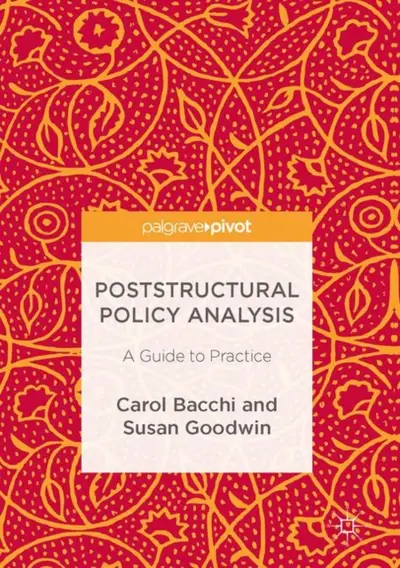
Poststructural Policy Analysis
A Guide to Practice
Price and availability
$87.99
Available in: Andorra, Austria, Australia, Belgium, Bulgaria, Canada, Switzerland, Cyprus, Czechia, Germany, Denmark, Estonia, Spain, Finland, France, United Kingdom, Guernsey, Greece, Croatia, Hungary, Ireland, Isle of Man, Iceland, Italy, Jersey, Japan, Liechtenstein, Lithuania, Luxembourg, Latvia, Monaco, Malta, Netherlands, Norway, Poland, Portugal, Romania, Sweden, Slovenia, Slovakia, San Marino, United States, Vatican City, South Africa
Stores: US, UK, Canada, EU, Australia.
Sign in to buyThe price is re-checked by the server before payment.
For personal use under the eBook licence.
- Format
- DRM
- Not stated by the publisher
- Language
- English
- Publisher
- Palgrave Macmillan US
- Published
- 24 October 2016
- ISBN
- 9781137525468
- Subjects
- Politics & government, Comparative politics, Constitution: government & the state, Political structures: democracy, Public administration, Central government policies, The Americas, Politics and government, Political science and theory, Comparative politics, Public administration / Public policy
About this book
This book offers a novel, refreshing and politically engaged way to think about public policy. Instead of treating policy as simply the government's best efforts to address problems, it offers a way to question critically how policies produce "e;problems"e; as particular sorts of problems, with important political implications. Governing, it is argued, takes place through these problematizations. According to the authors, interrogating policies and policy proposals as problematizations involves asking questions about the assumptions they rely upon, how they have been made, what their effects are, as well as how they could be unmade. To enable this form of critical analysis, this book introduces an analytic strategy, the "e;What's the Problem Represented to be?"e; (WPR) approach. It features examples of applications of the approach with topics as diverse as obesity, economic policy, migration, drug and alcohol policy, and gender equality to illustrate the growing popularity of this way of thinking and to provide clear and useful examples of poststructural policy analysis in practice.
Bibliographic data © Gardners Books Ltd.