PDF · English
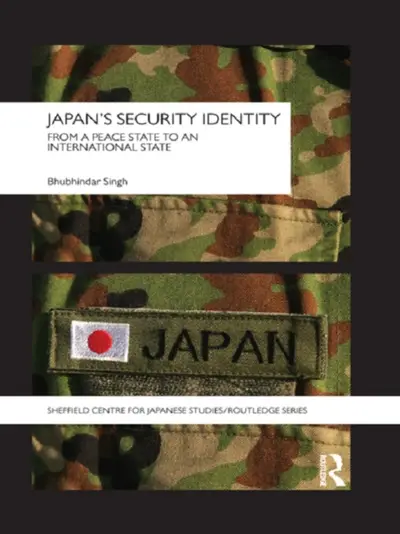
Japan's Security Identity
From a Peace-State to an International-State
Price and availability
$68.99
Available in: Andorra, Austria, Australia, Belgium, Bulgaria, Canada, Switzerland, Cyprus, Czechia, Germany, Denmark, Estonia, Spain, Finland, France, United Kingdom, Guernsey, Greece, Croatia, Hungary, Ireland, Isle of Man, Iceland, Italy, Jersey, Japan, Liechtenstein, Lithuania, Luxembourg, Latvia, Monaco, Malta, Netherlands, Norway, Poland, Portugal, Romania, Sweden, Slovenia, Slovakia, San Marino, United States, Vatican City, South Africa
Stores: US, UK, Canada, EU, Australia.
Sign in to buyThe price is re-checked by the server before payment.
For personal use under the eBook licence.
- Format
- DRM
- Not stated by the publisher
- Language
- English
- Publisher
- Taylor & Francis
- Published
- 12 December 2012
- ISBN
- 9781136189036
- Subjects
- Japan, Regional studies, Politics & government, Warfare & defence, Japan, Geopolitics, Warfare and defence
About this book
Since the end of the Cold War, there has been a significant change in Japanese security policy, as Japan's security identity has shifted from a peace state, to an international state. In this book, Bhubhindar Singh argues that from the 1990s onwards, the Japanese security policymaking elite recognized that its earlier approach to security policy which was influenced by the peace-state security identity was no longer appropriate. Rather, as a member of the international community, Japan had to carve out a responsible role in regional and international security affairs, which required greater emphasis on the role of the military in Japan's security policy. To explore the change in Japan's security identity and its associated security behaviour, this book contrasts the three areas that define and shape Japanese security policy: Japan's conception (or definition) of national security; the country's contribution, in military terms, to regional and international affairs; and the changes to the security policy regime responsible for the security policy formulation. Further, it seeks to challenge the dominant realist interpretation of Japanese security policy by adopting an identity-based approach and showing how whilst realist accounts correctly capture the trajectory of Japanese post-Cold War security policy, they fail to explain the underlying causes of the change in Japanese security behaviour in the post-Cold War period.This book is an important addition to the current literature on Japanese security policy, and will be of great use to students and scholars interested in Japanese and Asian politics, as well as security studies and international relations more broadly.
Bibliographic data © Gardners Books Ltd.