PDF · English
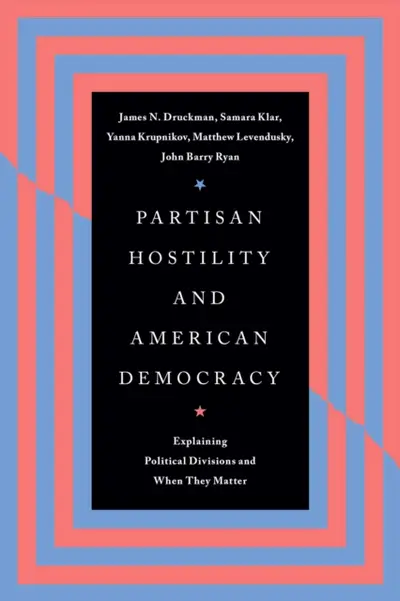
Partisan Hostility and American Democracy
Explaining Political Divisions and When They Matter
Price and availability
$40.99
Available in: Andorra, Austria, Australia, Belgium, Bulgaria, Canada, Switzerland, Cyprus, Czechia, Germany, Denmark, Estonia, Spain, Finland, France, United Kingdom, Guernsey, Greece, Croatia, Hungary, Ireland, Isle of Man, Iceland, Italy, Jersey, Japan, Liechtenstein, Lithuania, Luxembourg, Latvia, Monaco, Malta, Netherlands, Norway, Poland, Portugal, Romania, Sweden, Slovenia, Slovakia, San Marino, United States, Vatican City, South Africa
Stores: US, UK, Canada, EU, Australia.
Sign in to buyThe price is re-checked by the server before payment.
For personal use under the eBook licence.
- Format
- DRM
- Not stated by the publisher
- Language
- English
- Publisher
- University of Chicago Press
- Published
- 12 June 2024
- ISBN
- 9780226833668
- Subjects
- USA, Politics & government, Liberalism & centre democratic ideologies, Conservatism & right-of-centre democratic ideologies, Political structures: democracy, Political parties, Politics and government, Political ideologies and movements, Political structures / systems: democracy, Political parties and party platforms
About this book
An unflinching examination of the effects and boundaries of partisan animosity. For generations, experts argued that American politics needed cohesive parties to function effectively. Now many fear that strong partisan views, particularly hostility to the opposing party, are damaging democracy. Is partisanship as dangerous as we fear it is? To provide an answer, this book offers a nuanced evaluation of when and how partisan animosity matters in today's highly charged, dynamic political environment, drawing on panel data from some of the most tumultuous years in recent American history, 2019 through 2021. The authors show that partisanship powerfully shapes political behaviors, but its effects are conditional, not constant. Instead, it is most powerful when politicians send clear signals and when an issue is unlikely to bring direct personal consequences. In the absence of these conditions, other factors often dominate decision-making. The authors argue that while partisan hostility has degraded US politics-for example, politicizing previously non-political issues and undermining compromise-it is not in itself an existential threat. As their research shows, the future of American democracy depends on how politicians, more than ordinary voters, behave.
Bibliographic data © Gardners Books Ltd.