PDF · English
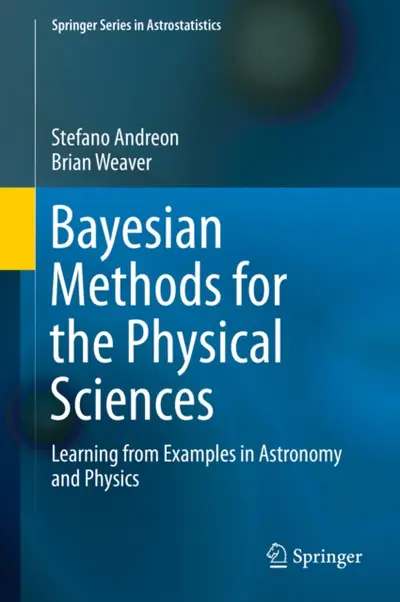
Bayesian Methods for the Physical Sciences
Learning from Examples in Astronomy and Physics
Price and availability
$148.99
Available in: Andorra, Austria, Australia, Belgium, Bulgaria, Canada, Switzerland, Cyprus, Czechia, Germany, Denmark, Estonia, Spain, Finland, France, United Kingdom, Guernsey, Greece, Croatia, Hungary, Ireland, Isle of Man, Iceland, Italy, Jersey, Japan, Liechtenstein, Lithuania, Luxembourg, Latvia, Monaco, Malta, Netherlands, Norway, Poland, Portugal, Romania, Sweden, Slovenia, Slovakia, San Marino, United States, Vatican City, South Africa
Stores: US, UK, Canada, EU, Australia.
Sign in to buyThe price is re-checked by the server before payment.
For personal use under the eBook licence.
- Format
- DRM
- Not stated by the publisher
- Language
- English
- Publisher
- Springer International Publishing
- Published
- 19 May 2015
- ISBN
- 9783319152875
- Subjects
- Probability & statistics, Bayesian inference, Astronomy, space & time, Theoretical & mathematical astronomy, Mathematical physics, Astrophysics, Probability and statistics, Astronomy, space and time, Mathematical / Computational / Theoretical physics
About this book
Statistical literacy is critical for the modern researcher in Physics and Astronomy. This book empowers researchers in these disciplines by providing the tools they will need to analyze their own data. Chapters in this book provide a statistical base from which to approach new problems, including numerical advice and a profusion of examples. The examples are engaging analyses of real-world problems taken from modern astronomical research. The examples are intended to be starting points for readers as they learn to approach their own data and research questions. Acknowledging that scientific progress now hinges on the availability of data and the possibility to improve previous analyses, data and code are distributed throughout the book. The JAGS symbolic language used throughout the book makes it easy to perform Bayesian analysis and is particularly valuable as readers may use it in a myriad of scenarios through slight modifications.This book is comprehensive, well written, and will surely be regarded as a standard text in both astrostatistics and physical statistics.Joseph M. Hilbe, President, International Astrostatistics Association, Professor Emeritus, University of Hawaii, and Adjunct Professor of Statistics, Arizona State University
Bibliographic data © Gardners Books Ltd.