PDF · English
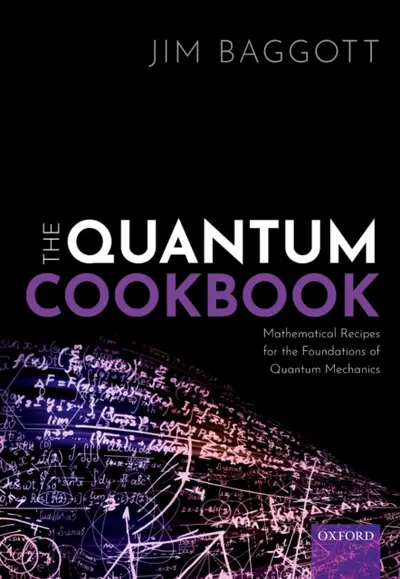
Quantum Cookbook
Mathematical Recipes for the Foundations of Quantum Mechanics
Price and availability
$28.99
Available in: Andorra, Austria, Australia, Belgium, Bulgaria, Canada, Switzerland, Cyprus, Czechia, Germany, Denmark, Estonia, Spain, Finland, France, United Kingdom, Guernsey, Greece, Croatia, Hungary, Ireland, Isle of Man, Iceland, Italy, Jersey, Japan, Liechtenstein, Lithuania, Luxembourg, Latvia, Monaco, Malta, Netherlands, Norway, Poland, Portugal, Romania, Sweden, Slovenia, Slovakia, San Marino, United States, Vatican City, South Africa
Stores: US, UK, Canada, EU, Australia.
Sign in to buyThe price is re-checked by the server before payment.
For personal use under the eBook licence.
- Format
- DRM
- Not stated by the publisher
- Language
- English
- Publisher
- Oxford University Press
- Published
- 10 January 2020
- ISBN
- 9780192562890
- Subjects
- Popular science, Quantum physics (quantum mechanics & quantum field theory), Popular science, Quantum physics (quantum mechanics and quantum field theory)
About this book
Quantum mechanics is an extraordinarily successful scientific theory. But it is also completely mad. Although the theory quite obviously works, it leaves us chasing ghosts and phantoms; particles that are waves and waves that are particles; cats that are at once both alive and dead; lots of seemingly spooky goings-on; and a desperate desire to lie down quietly in a darkened room. The Quantum Cookbook explains why this is. It provides a unique bridge between popular exposition and formal textbook presentation, written for curious readers with some background in physics and sufficient mathematical capability. It aims not to teach readers how to do quantum mechanics but rather helps them to understand how to think about quantum mechanics. Each derivation is presented as a 'recipe' with listed ingredients, including standard results from the mathematician's toolkit, set out in a series of easy-to-follow steps. The recipes have been written sympathetically, for readers who - like the author - will often struggle to follow the logic of a derivation which misses out steps that are 'obvious', or which use techniques that readers are assumed to know.
Bibliographic data © Gardners Books Ltd.