PDF · English
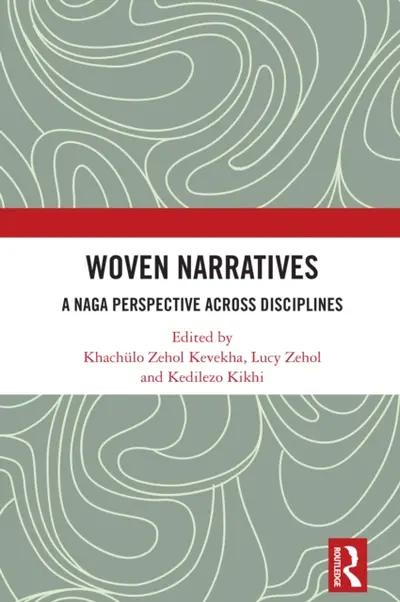
Woven Narratives
A Naga Perspective Across Disciplines
- Literary studies & poetry
- Society & social sciences
- Politics & law
- Nature, environment & geography
- Philosophy & religion
- Reference
Price and availability
$64.99
Available in: Andorra, Austria, Australia, Belgium, Bulgaria, Canada, Switzerland, Cyprus, Czechia, Germany, Denmark, Estonia, Spain, Finland, France, United Kingdom, Guernsey, Greece, Croatia, Hungary, Ireland, Isle of Man, Iceland, Italy, Jersey, Japan, Liechtenstein, Lithuania, Luxembourg, Latvia, Monaco, Malta, Netherlands, Norway, Poland, Portugal, Romania, Sweden, Slovenia, Slovakia, San Marino, United States, Vatican City, South Africa
Stores: US, UK, Canada, EU, Australia.
Sign in to buyThe price is re-checked by the server before payment.
For personal use under the eBook licence.
- Format
- DRM
- Not stated by the publisher
- Language
- English
- Publisher
- Taylor & Francis
- Published
- 24 July 2026
- ISBN
- 9781040965313
- Subjects
- Indian sub-continent, Regional studies, Rural communities, Urban communities, Sociology, Anthropology, Social & cultural anthropology, ethnography, Psychology, Politics & government, Central government policies, Environmental policy & protocols, North East India, Literary studies: fiction, novelists and prose writers, Social and cultural anthropology, Indigenous peoples: religions, belief systems, cultural worldviews and spiritual beliefs
About this book
This volume offers a nuanced exploration of Naga society, moving beyond simplistic narratives of tradition versus modernity to reveal the complex processes of negotiation, continuity, and transformation that define contemporary Naga experiences. It emphasises that to understand Northeast India, especially Naga societies, one must engage with its dynamic negotiations of identity, belief, gender and belonging.This collection brings together 15 essays that explore the cultural, spiritual, political and literary landscapes of the Naga people and their neighbours, demonstrating how these realms continuously interact, overlap and reshape one another in daily life. From borderland solidarities and Christian-shamanic syncretism to the gendered meanings of folktales, material objects and marriage rites, the chapters reveal how tradition and transformation are deeply intertwined. Drawing from ethnography, oral histories, literary analysis and empirical research, the contributors offer rich insights into a region often overlooked in mainstream Indian and global scholarship. Whether examining the symbolic power of the were-tiger in fiction, the role of Satyagraha in Ao Naga ethics or the health challenges of Angami elders, this book refuses simplistic binaries and challenges fixed perceptions of indigenous existence.The book is an essential read for scholars of Indigenous studies, religion, gender, borderlands and postcolonial South Asia and also for anyone seeking to understand the complexity and vitality of life in Northeast India today. It will be of interest to scholars and researchers of psychology, anthropology, sociology, environmental sciences, development studies, law and governance, environmental administration and South Asian studies. It will also be an invaluable and interesting read for those interested in South Asian studies.
Bibliographic data © Gardners Books Ltd.