PDF · English
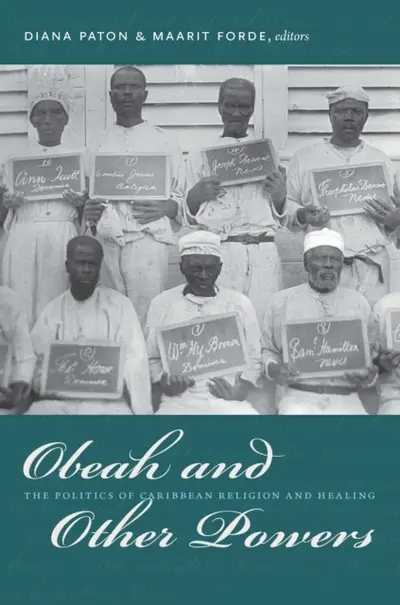
Obeah and Other Powers
The Politics of Caribbean Religion and Healing
Price and availability
$54.99
Available in: Andorra, Austria, Australia, Belgium, Bulgaria, Canada, Switzerland, Cyprus, Czechia, Germany, Denmark, Estonia, Spain, Finland, France, United Kingdom, Guernsey, Greece, Croatia, Hungary, Ireland, Isle of Man, Iceland, Italy, Jersey, Japan, Liechtenstein, Lithuania, Luxembourg, Latvia, Monaco, Malta, Netherlands, Norway, Poland, Portugal, Romania, Sweden, Slovenia, Slovakia, San Marino, United States, Vatican City, South Africa
Stores: US, UK, Canada, EU, Australia.
Sign in to buyThe price is re-checked by the server before payment.
For personal use under the eBook licence.
- Format
- DRM
- Not stated by the publisher
- Language
- English
- Publisher
- Duke University Press
- Published
- 13 April 2012
- ISBN
- 9780822394839
- Subjects
- Caribbean islands, History of the Americas, Religion: general, Other non-Christian religions, Social & cultural anthropology, ethnography, Caribbean islands, Social and cultural anthropology, NHK, QRA, QRR
About this book
In Obeah and Other Powers, historians and anthropologists consider how marginalized spiritual traditions-such as obeah, Vodou, and Santeria-have been understood and represented across the Caribbean since the seventeenth century. In essays focused on Cuba, Haiti, Jamaica, Martinique, Puerto Rico, Trinidad and Tobago, and the wider Anglophone Caribbean, the contributors explore the fields of power within which Caribbean religions have been produced, modified, appropriated, and policed. The "e;other powers"e; of the book's title have helped to shape, or attempted to curtail, Caribbean religions and healing practices. These powers include those of capital and colonialism; of states that criminalize some practices and legitimize others; of occupying armies that rewrite constitutions and reorient economies; of writers, filmmakers, and scholars who represent Caribbean practices both to those with little knowledge of the region and to those who live there; and, not least, of the millions of people in the Caribbean whose relationships with one another, as well as with capital and the state, have long been mediated and experienced through religious formations and discourses.Contributors. Kenneth Bilby, Erna Brodber, Alejandra Bronfman, Elizabeth Cooper, Maarit Forde, Stephan Palmie, Diana Paton, Alasdair Pettinger, Lara Putnam, Karen Richman, Raquel Romberg, John Savage, Katherine Smith
Bibliographic data © Gardners Books Ltd.