PDF · English
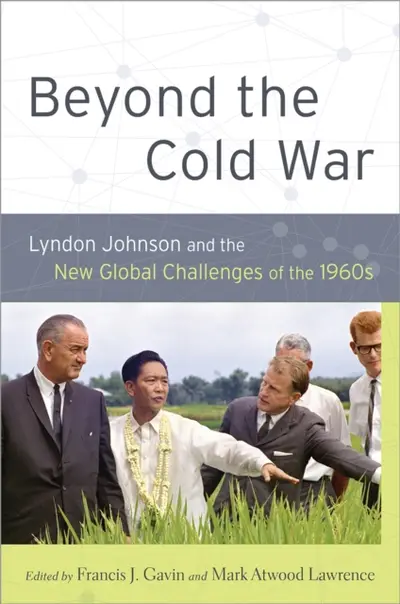
Beyond the Cold War
Lyndon Johnson and the New Global Challenges of the 1960s
Price and availability
$37.99
Available in: Andorra, Austria, Australia, Belgium, Bulgaria, Canada, Switzerland, Cyprus, Czechia, Germany, Denmark, Estonia, Spain, Finland, France, United Kingdom, Guernsey, Greece, Croatia, Hungary, Ireland, Isle of Man, Iceland, Italy, Jersey, Japan, Liechtenstein, Lithuania, Luxembourg, Latvia, Monaco, Malta, Netherlands, Norway, Poland, Portugal, Romania, Sweden, Slovenia, Slovakia, San Marino, United States, Vatican City, South Africa
Stores: US, UK, Canada, EU, Australia.
Sign in to buyThe price is re-checked by the server before payment.
For personal use under the eBook licence.
- Format
- DRM
- Not stated by the publisher
- Language
- English
- Publisher
- Oxford University Press
- Published
- 17 December 2013
- ISBN
- 9780199790777
- Subjects
- USA, 20th century, c 1960 to c 1970, General & world history, History of the Americas, Postwar 20th century history, from c 1945 to c 2000, International relations, United States of America, USA, 3MP, 3MPQS, International relations, NH, NHB, NHK
About this book
In writing about international affairs in the 1960s, historians have naturally focused on the Cold War. The decade featured perilous confrontations between the United States and the Soviet Union over Berlin and Cuba, the massive buildup of nuclear stockpiles, the escalation of war in Vietnam, and bitter East-West rivalry throughout the developing world. As the world historical force of globalization has quickened and deepened, however, historians have begun to see that many of the global challenges that we face todayBeyond the Cold War examines how the administration of President Lyndon B. Johnson responded to this changing international landscape. To what extent did U.S. leaders understand these changes? How did they prioritize these issues alongside the geostrategic concerns that dominated their daily agendas and the headlines of the day? How successfully did Americans grapple with these long-range problems, with what implications for the future? What lessons lie in the efforts of Johnson and his aides to cope with a new and inchoate agenda of problems? By reconsidering the 1960s, this work suggests a new research agenda predicated on the idea that the Cold War was not the only - or perhaps even the most important - feature of international life in the postwar period.
Bibliographic data © Gardners Books Ltd.