EPUB · English
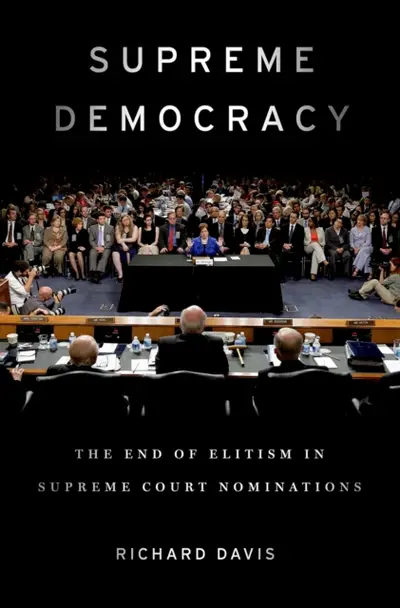
Supreme Democracy
The End of Elitism in Supreme Court Nominations
Price and availability
$25.99
Available in: Andorra, Austria, Australia, Belgium, Bulgaria, Canada, Switzerland, Cyprus, Czechia, Germany, Denmark, Estonia, Spain, Finland, France, United Kingdom, Guernsey, Greece, Croatia, Hungary, Ireland, Isle of Man, Iceland, Italy, Jersey, Japan, Liechtenstein, Lithuania, Luxembourg, Latvia, Monaco, Malta, Netherlands, Norway, Poland, Portugal, Romania, Sweden, Slovenia, Slovakia, San Marino, United States, Vatican City, South Africa
Stores: US, UK, Canada, EU, Australia.
Sign in to buyThe price is re-checked by the server before payment.
For personal use under the eBook licence.
- Format
- EPUB
- DRM
- Not stated by the publisher
- Language
- English
- Publisher
- Oxford University Press
- Published
- 6 June 2017
- ISBN
- 9780190656980
- Subjects
- USA, Constitution: government & the state, Courts & procedure, United States of America, USA, Constitution: government and the state, Legal systems: courts and procedures
About this book
In the nineteenth and early twentieth centuries, Supreme Court nominations were driven by presidents, senators, and some legal community elites. Many nominations were quick processes with little Senate deliberation, minimal publicity and almost no public involvement. Today, however, confirmation takes 81 days on average-Justice Antonin Scalia's former seat has already taken much longer to fill-and it is typically a media spectacle. How did the Supreme Court nomination process become so public and so nakedly political? What forces led to the current high-stakes status of the process? How could we implement reforms to improve the process? In Supreme Democracy: The End of Elitism in the Supreme Court Nominations, Richard Davis, an eminent scholar of American politics and the courts, traces the history of nominations from the early republic to the present. He examines the component parts of the nomination process one by one: the presidential nomination stage, the confirmation management process, the role of the Senate Judiciary Committee, and the increasing involvement over time of interest groups, the news media, and public opinion. The most dramatic development, however, has been the democratization of politics. Davis delves into the constitutional underpinnings of the nomination process and its traditional form before describing a more democratic process that has emerged in the past half century. He details the struggle over image-making between supporters and opponents intended to influence the news media and public opinion. Most importantly, he provides a thorough examination of whether or not increasing democracy always produces better governance, and a better Court. Not only an authoritative analysis of the Supreme Court nomination process from the founding era to the present, Supreme Democracy will be an essential guide to all of the protracted nomination battles yet to come.
Bibliographic data © Gardners Books Ltd.