EPUB · English
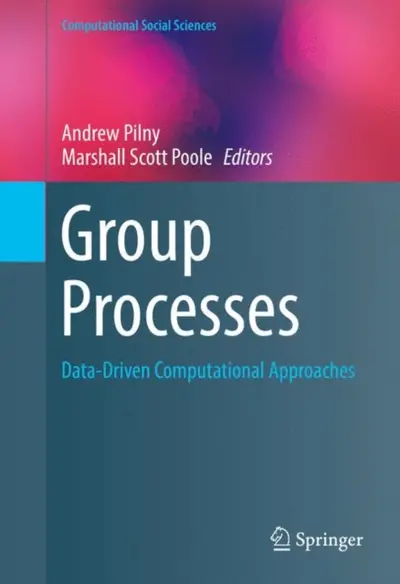
Group Processes
Data-Driven Computational Approaches
Price and availability
$148.99
Available in: Andorra, Austria, Australia, Belgium, Bulgaria, Canada, Switzerland, Cyprus, Czechia, Germany, Denmark, Estonia, Spain, Finland, France, United Kingdom, Guernsey, Greece, Croatia, Hungary, Ireland, Isle of Man, Iceland, Italy, Jersey, Japan, Liechtenstein, Lithuania, Luxembourg, Latvia, Monaco, Malta, Netherlands, Norway, Poland, Portugal, Romania, Sweden, Slovenia, Slovakia, San Marino, United States, Vatican City, South Africa
Stores: US, UK, Canada, EU, Australia.
Sign in to buyThe price is re-checked by the server before payment.
For personal use under the eBook licence.
- Format
- EPUB
- DRM
- Not stated by the publisher
- Language
- English
- Publisher
- Springer International Publishing
- Published
- 7 March 2017
- ISBN
- 9783319489414
- Subjects
- Sociology, Social research & statistics, Occupational & industrial psychology, Knowledge management, Probability & statistics, Databases, Data mining, Computer science, Computer modelling & simulation, Sociology, Occupational and industrial psychology, Knowledge management, Databases / Data management, Data mining, Computer modelling and simulation, Expert systems / knowledge-based systems
About this book
This volume introduces a series of different data-driven computational methods for analyzing group processes through didactic and tutorial-based examples. Group processes are of central importance to many sectors of society, including government, the military, health care, and corporations. Computational methods are better suited to handle (potentially huge) group process data than traditional methodologies because of their more flexible assumptions and capability to handle real-time trace data.Indeed, the use of methods under the name of computational social science have exploded over the years. However, attention has been focused on original research rather than pedagogy, leaving those interested in obtaining computational skills lacking a much needed resource. Although the methods here can be applied to wider areas of social science, they are specifically tailored to group process research.A number of data-driven methodsadapted to group process research are demonstrated in this current volume. These include text mining, relational event modeling, social simulation, machine learning, social sequence analysis, and response surface analysis. In order to take advantage of these new opportunities, this book provides clear examples (e.g., providing code) of group processes in various contexts, setting guidelines and best practices for future work to build upon.This volume will be of great benefit to those willing to learn computational methods. These include academics like graduate students and faculty, multidisciplinary professionals and researchers working on organization and management science, and consultants for various types of organizations and groups.
Bibliographic data © Gardners Books Ltd.