PDF · English
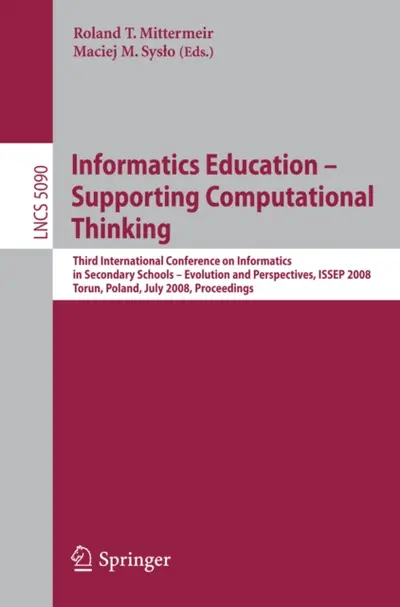
Informatics Education - Supporting Computational Thinking
Third International Conference on Informatics in Secondary Schools - Evolution and Perspectives, ISSEP 2008 Torun Poland, July 1-4, 2008 Proceedings
Price and availability
$60.99
Available in: Andorra, Austria, Australia, Belgium, Bulgaria, Canada, Switzerland, Cyprus, Czechia, Germany, Denmark, Estonia, Spain, Finland, France, United Kingdom, Guernsey, Greece, Croatia, Hungary, Ireland, Isle of Man, Iceland, Italy, Jersey, Japan, Liechtenstein, Lithuania, Luxembourg, Latvia, Monaco, Malta, Netherlands, Norway, Poland, Portugal, Romania, Sweden, Slovenia, Slovakia, San Marino, United States, Vatican City, South Africa
Stores: US, UK, Canada, EU, Australia.
Sign in to buyThe price is re-checked by the server before payment.
For personal use under the eBook licence.
- Format
- DRM
- Not stated by the publisher
- Language
- English
- Publisher
- Springer Berlin Heidelberg
- Published
- 27 June 2008
- ISBN
- 9783540699248
- Subjects
- Educational equipment & technology, computer-aided learning (CAL), Ethical & social aspects of IT, Personal computers, Educational equipment and technology, computer-aided learning (CAL), Digital and information technologies: social and ethical aspects, Personal computers
About this book
Informatics Education - Supporting Computational Thinking contains papers presented at the Third International Conference on Informatics in Secondary Schools - Evolution and Perspective, ISSEP 2008, held in July 2008 in Torun, Poland. As with the proceedings of the two previous ISSEP conferences (2005 in Klag- furt, Austria, and 2006 in Vilnius, Lithuania), the papers presented in this volume address issues of informatics education transcending national boundaries and, the- fore, transcending differences in the various national legislation and organization of the educational system. Observing these issues, one might notice a trend. The p- ceedings of the First ISSEP were termed From Computer Literacy to Informatics F- damentals [1]. There, broad room was given to general education in ICT. The ECDL, the European Computer Driving License, propagated since the late 1990s, had pe- trated school at this time already on a broad scale and teachers, parents, as well as pupils were rather happy with this situation. Teachers had material that had a clear scope, was relatively easy to teach, and especially easy to examine. Parents had the assurance that their children learn "e;modern and relevant stuff,"e; and for kids the c- puter was sufficiently modern so that anything that had to do with computers was c- sidered to be attractive. Moreover, the difficulties of programming marking the early days of informatics education in school seemed no longer relevant. Some colleagues had a more distant vision though.
Bibliographic data © Gardners Books Ltd.