PDF · English
Seneca Effect
Why Growth is Slow but Collapse is Rapid
- Society & social sciences
- Economics, business & finance
- Science & mathematics
- Technology & engineering
- Reference
Price and availability
$100.99
Available in: Andorra, Austria, Australia, Belgium, Bulgaria, Canada, Switzerland, Cyprus, Czechia, Germany, Denmark, Estonia, Spain, Finland, France, United Kingdom, Guernsey, Greece, Croatia, Hungary, Ireland, Isle of Man, Iceland, Italy, Jersey, Japan, Liechtenstein, Lithuania, Luxembourg, Latvia, Monaco, Malta, Netherlands, Norway, Poland, Portugal, Romania, Sweden, Slovenia, Slovakia, San Marino, United States, Vatican City, South Africa
Stores: US, UK, Canada, EU, Australia.
Sign in to buyThe price is re-checked by the server before payment.
For personal use under the eBook licence.
- Format
- DRM
- Not stated by the publisher
- Language
- English
- Publisher
- Springer International Publishing
- Published
- 22 August 2017
- ISBN
- 9783319572079
- Subjects
- Cybernetics & systems theory, Sociology, Sociology: work & labour, Political economy, Chaos theory, Condensed matter physics (liquid state & solid state physics), Optical physics, Engineering: general, Maths for engineers, Materials science, Cybernetics and systems theory, Sociology: work and labour, Political economy, Condensed matter physics (liquid state and solid state physics), Optical physics, Maths for engineers
About this book
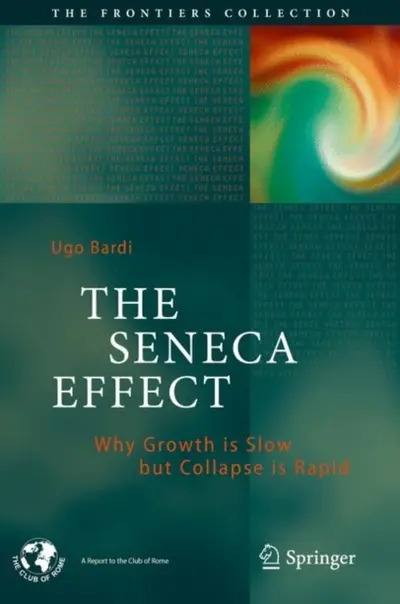
The essence of this book can be found in a line written by the ancient Roman Stoic Philosopher Lucius Annaeus Seneca: "e;Fortune is of sluggish growth, but ruin is rapid"e;. This sentence summarizes the features of the phenomenon that we call "e;collapse,"e; which is typically sudden and often unexpected, like the proverbial "e;house of cards."e; But why are such collapses so common, and what generates them? Several books have been published on the subject, including the well known "e;Collapse"e; by Jared Diamond (2005), "e;The collapse of complex societies"e; by Joseph Tainter (1998) and "e;The Tipping Point,"e; by Malcom Gladwell (2000). Why The Seneca Effect? This book is an ambitious attempt to pull these various strands together by describing collapse from a multi-disciplinary viewpoint. The reader will discover how collapse is a collective phenomenon that occurs in what we call today "e;complex systems,"e; with a special emphasis on system dynamics and the concept of "e;feedback."e; From this foundation, Bardi applies the theory to real-world systems, from the mechanics of fracture and the collapse of large structures to financial collapses, famines and population collapses, the fall of entire civilzations, and the most dreadful collapse we can imagine: that of the planetary ecosystem generated by overexploitation and climate change. The final objective of the book is to describe a conclusion that the ancient stoic philosophers had already discovered long ago, but that modern system science has rediscovered today. If you want to avoid collapse you need to embrace change, not fight it. Neither a book about doom and gloom nor a cornucopianist's dream, The Seneca Effect goes to the heart of the challenges that we are facing today, helping us to manage our future rather than be managed by it.
Bibliographic data © Gardners Books Ltd.