PDF · English
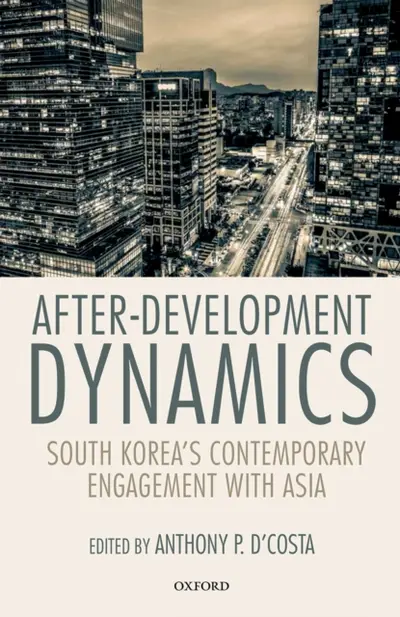
After-Development Dynamics
South Korea's Contemporary Engagement with Asia
Price and availability
$110.99
Available in: Andorra, Austria, Australia, Belgium, Bulgaria, Canada, Switzerland, Cyprus, Czechia, Germany, Denmark, Estonia, Spain, Finland, France, United Kingdom, Guernsey, Greece, Croatia, Hungary, Ireland, Isle of Man, Iceland, Italy, Jersey, Japan, Liechtenstein, Lithuania, Luxembourg, Latvia, Monaco, Malta, Netherlands, Norway, Poland, Portugal, Romania, Sweden, Slovenia, Slovakia, San Marino, United States, Vatican City, South Africa
Stores: US, UK, Canada, EU, Australia.
Sign in to buyThe price is re-checked by the server before payment.
For personal use under the eBook licence.
- Format
- DRM
- Not stated by the publisher
- Language
- English
- Publisher
- Oxford University Press
- Published
- 30 July 2015
- ISBN
- 9780191045738
- Subjects
- South Korea, Migration, immigration & emigration, Macroeconomics, Economic growth, International economics, Development economics & emerging economies, Migration, immigration and emigration, Macroeconomics, Economic growth, International economics, Development economics and emerging economies
About this book
The South Korean economic development trajectory has been widely studied and is well understood. From an impoverished war-torn nation, the country has progressed on all fronts, including a ten-fold increase in per capita income over a 40 year period. It stands out internationally when it comes to education and politically it has moved away from authoritarianism to a more spirited democratic system. In short, it seems to have achieved it all. The question then is, what does a country do after it has attained development? This volume examines Korea's strategic engagement with Asia as a response to the limits of the home market. Access to new markets and resources in Asia through exports and foreign investment are critical. Additionally, with Korea's ongoing demographic crisis, its engagement with foreign workers is also inevitable. After-Development Dynamics explores how Korea is responding through regional integration, strategic industrial upgrading of exports, foreign markets and resources, and coping with migrants, including unskilled workers, students, and professionals. The transfer of Korean business and employment practices through investment to other countries and accommodating foreigners is not trouble-free. Further, prosperity imposes demands for increased social welfare, while the workings of contemporary global capitalism introduce new sources of inequality. Sharing that prosperity with small firms, irregular workers, and women becomes critical. This volume presents the key internal challenges facing Korean society and suggests multiple ways to address them as a related response to Korea's after-development prosperity.
Bibliographic data © Gardners Books Ltd.