PDF · English
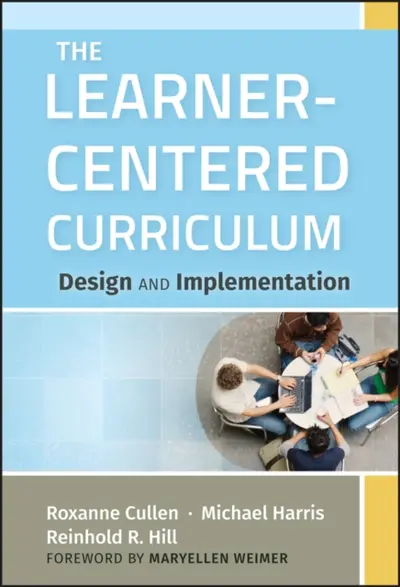
Learner-Centered Curriculum
Design and Implementation
Price and availability
$48.99
Available in: Andorra, Austria, Australia, Belgium, Bulgaria, Canada, Switzerland, Cyprus, Czechia, Germany, Denmark, Estonia, Spain, Finland, France, United Kingdom, Guernsey, Greece, Croatia, Hungary, Ireland, Isle of Man, Iceland, Italy, Jersey, Japan, Liechtenstein, Lithuania, Luxembourg, Latvia, Monaco, Malta, Netherlands, Norway, Poland, Portugal, Romania, Sweden, Slovenia, Slovakia, San Marino, United States, Vatican City, South Africa
Stores: US, UK, Canada, EU, Australia.
Sign in to buyThe price is re-checked by the server before payment.
For personal use under the eBook licence.
- Format
- DRM
- Not stated by the publisher
- Language
- English
- Publisher
- Wiley
- Published
- 3 February 2012
- ISBN
- 9781118171004
- Subjects
- Education, Curriculum planning & development, Education / Educational sciences / Pedagogy, JNDG
About this book
THE LEARNER-CENTERED CURRICULUM If an institution is to be truly learner-centered, all processes and practices need to be learner-centered, and the curriculum is no exception. From the Preface The Learner-Centered Curriculum is for educators and administrators who envision an educational environment that produces students who are creative and autonomous learners. By encouraging an appreciation and adoption of learner-centered practices, educators can transform their curricula to become more focused on the learner. The book presents a framework for curriculum design based on learner-centered principles while at the same time offering technical advice on implementation as well as the strategic use of assessment, technology, and physical spaces to support innovative design. The authors include several examples of existing curricula that illustrate their framework in practice. Throughout the book, they emphasize the need for assessment, both formative and summative, stressing the point that assessment is an effective driver of change. The book includes a wide variety of options both for individual classroom practice and for programmatic assessment. The Learner-Centered Curriculum explores the current technology and tools available to educators that can support learner-centered practices and foster autonomous learning and demonstrates how technology can assist in removing some of the obstacles to achieving a learner-centered design. In addition, the authors explain the importance of physical spaces in relation to learner-centered curricular design and show how to tie renovation to curricular implementation to foster incentive to innovate and provide a physical manifestation of learner-centered principles.
Bibliographic data © Gardners Books Ltd.