PDF · English
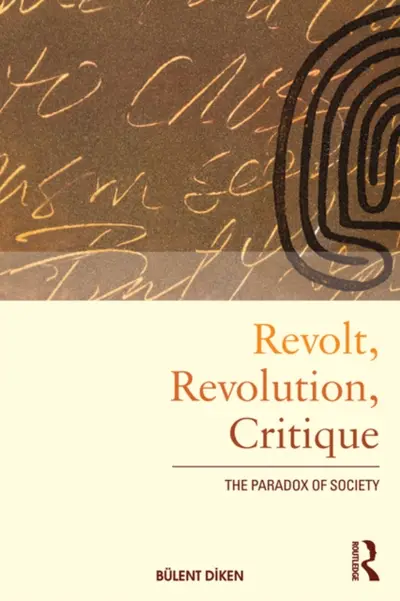
Revolt, Revolution, Critique
The Paradox of Society
Price and availability
$68.99
Available in: Andorra, Austria, Australia, Belgium, Bulgaria, Canada, Switzerland, Cyprus, Czechia, Germany, Denmark, Estonia, Spain, Finland, France, United Kingdom, Guernsey, Greece, Croatia, Hungary, Ireland, Isle of Man, Iceland, Italy, Jersey, Japan, Liechtenstein, Lithuania, Luxembourg, Latvia, Monaco, Malta, Netherlands, Norway, Poland, Portugal, Romania, Sweden, Slovenia, Slovakia, San Marino, United States, Vatican City, South Africa
Stores: US, UK, Canada, EU, Australia.
Sign in to buyThe price is re-checked by the server before payment.
For personal use under the eBook licence.
- Format
- DRM
- Not stated by the publisher
- Language
- English
- Publisher
- Taylor & Francis
- Published
- 15 March 2012
- ISBN
- 9781134005642
- Subjects
- Revolutions, uprisings, rebellions, Sociology, Sociology, NHTV
About this book
In contemporary society the idea of 'revolution' seems to have become obsolete. What is more untimely than the idea of revolution today? At the same time, however, the idea of radical change no longer refers to exceptional circumstances but has become normalized as part of daily life. Ours is a 'culture' of permanent revolution in which constant systemic disembedding demands a meta-stable subjectivity in continuous transformation. In this sense, the idea of revolution is painfully timely. This paradoxical coincidence, the simultaneous absence and presence of the desire for radical change in contemporary society, is the point of departure for the symptomatic reading this book offers. The book addresses the social, political and cultural significance of revolt and revolution in three dimensions. First, it analyzes revolt and revolution as 'events' which are of history but not reducible to it. Second, it elaborates on theories that grant revolt and revolution a central place in their structure. Thirdly, it discusses revolutionary or emancipatory theories that seek to participate in radical change. Further, since both revolt and revolution involve the critique of what exists, of actual reality, the implications of the intimate relationship between revolt, revolution and critique are explicated.
Bibliographic data © Gardners Books Ltd.