EPUB · English
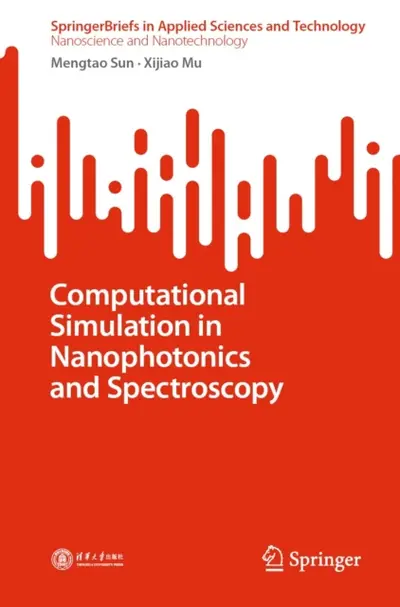
Computational Simulation in Nanophotonics and Spectroscopy
Price and availability
$60.99
Available in: Andorra, Austria, Australia, Belgium, Bulgaria, Canada, Switzerland, Cyprus, Czechia, Germany, Denmark, Estonia, Spain, Finland, France, United Kingdom, Guernsey, Greece, Croatia, Hungary, Ireland, Isle of Man, Iceland, Italy, Jersey, Japan, Liechtenstein, Lithuania, Luxembourg, Latvia, Monaco, Malta, Netherlands, Norway, Poland, Portugal, Romania, Sweden, Slovenia, Slovakia, San Marino, United States, Vatican City, South Africa
Stores: US, UK, Canada, EU, Australia.
Sign in to buyThe price is re-checked by the server before payment.
For personal use under the eBook licence.
- Format
- EPUB
- DRM
- Not stated by the publisher
- Language
- English
- Publisher
- Springer Nature Singapore
- Published
- 27 September 2023
- ISBN
- 9789819947324
- Subjects
- Chaos theory, Optical physics, Spectrum analysis, spectrochemistry, mass spectrometry, Physical chemistry, Nanotechnology, Materials science, Electronics engineering, Electronic devices & materials, Computer modelling & simulation, Optical physics, Spectrum analysis, spectrochemistry, mass spectrometry, Nanotechnology, Materials science, Electronic devices and materials, Computer modelling and simulation
About this book
Nanophotonics and spectroscopy has advanced rapidly in recent years. Experimental research on nanophotonics is very active. In addition to experimental research on the principles and applications of nanophotonics, computational simulation research on its various physical mechanisms and phenomena is equally important. The simulation of the optical properties of molecules or crystals, such as electronic spectra (absorption and emission spectra, etc.) and vibrational spectroscopy has extraordinary guiding significance for experiments. The current computational simulation technology can also explain and analyze the physical mechanisms behind phenomena. However, among the many computational simulation software programs available, the operation methods and application scenarios are different. The barrier for new users to conduct research with computational simulation is high. Even for researchers with some experience, it is not easy to develop a comprehensive understanding of the various software programs, keywords, programming languages and auxiliary programs. This book serves as an introductory book for beginners to get started with the technology, and a handbook for experienced readers to quickly look up for commands and script usage. It is a handy reference for graduate students and researchers engaged in the study of photonics and optics.
Bibliographic data © Gardners Books Ltd.