PDF · English
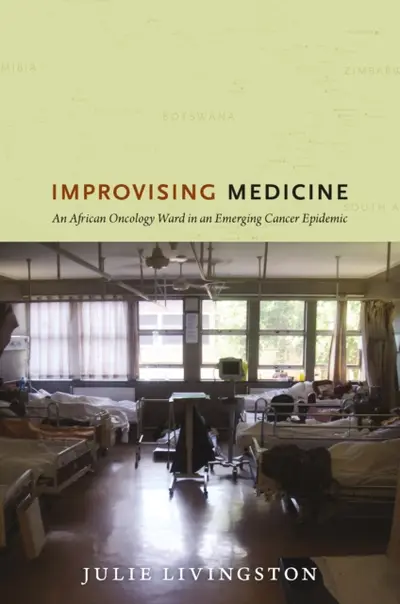
Improvising Medicine
An African Oncology Ward in an Emerging Cancer Epidemic
Price and availability
$36.99
Available in: Andorra, Austria, Australia, Belgium, Bulgaria, Canada, Switzerland, Cyprus, Czechia, Germany, Denmark, Estonia, Spain, Finland, France, United Kingdom, Guernsey, Greece, Croatia, Hungary, Ireland, Isle of Man, Iceland, Italy, Jersey, Japan, Liechtenstein, Lithuania, Luxembourg, Latvia, Monaco, Malta, Netherlands, Norway, Poland, Portugal, Romania, Sweden, Slovenia, Slovakia, San Marino, United States, Vatican City, South Africa
Stores: US, UK, Canada, EU, Australia.
Sign in to buyThe price is re-checked by the server before payment.
For personal use under the eBook licence.
- Format
- DRM
- Not stated by the publisher
- Language
- English
- Publisher
- Duke University Press
- Published
- 1 August 2012
- ISBN
- 9780822395768
- Subjects
- Africa, Southern Africa, African history, Social & cultural anthropology, ethnography, Public health & preventive medicine, Health systems & services, Oncology, Social and cultural anthropology, Public health and preventive medicine, Health systems and services, Oncology, NHH
About this book
In Improvising Medicine, Julie Livingston tells the story of Botswana's only dedicated cancer ward, located in its capital city of Gaborone. This affecting ethnography follows patients, their relatives, and ward staff as a cancer epidemic emerged in Botswana. The epidemic is part of an ongoing surge in cancers across the global south; the stories of Botswana's oncology ward dramatize the human stakes and intellectual and institutional challenges of an epidemic that will shape the future of global health. They convey the contingencies of high-tech medicine in a hospital where vital machines are often broken, drugs go in and out of stock, and bed-space is always at a premium. They also reveal cancer as something that happens between people. Serious illness, care, pain, disfigurement, and even death emerge as deeply social experiences. Livingston describes the cancer ward in terms of the bureaucracy, vulnerability, power, biomedical science, mortality, and hope that shape contemporary experience in southern Africa. Her ethnography is a profound reflection on the social orchestration of hope and futility in an African hospital, the politics and economics of healthcare in Africa, and palliation and disfigurement across the global south.
Bibliographic data © Gardners Books Ltd.