PDF · English
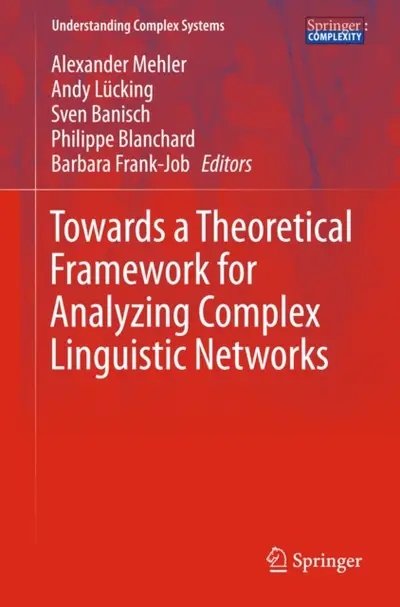
Towards a Theoretical Framework for Analyzing Complex Linguistic Networks
Price and availability
$120.99
Available in: Andorra, Austria, Australia, Belgium, Bulgaria, Canada, Switzerland, Cyprus, Czechia, Germany, Denmark, Estonia, Spain, Finland, France, United Kingdom, Guernsey, Greece, Croatia, Hungary, Ireland, Isle of Man, Iceland, Italy, Jersey, Japan, Liechtenstein, Lithuania, Luxembourg, Latvia, Monaco, Malta, Netherlands, Norway, Poland, Portugal, Romania, Sweden, Slovenia, Slovakia, San Marino, United States, Vatican City, South Africa
Stores: US, UK, Canada, EU, Australia.
Sign in to buyThe price is re-checked by the server before payment.
For personal use under the eBook licence.
- Format
- DRM
- Not stated by the publisher
- Language
- English
- Publisher
- Springer Berlin Heidelberg
- Published
- 7 July 2015
- ISBN
- 9783662472385
- Subjects
- linguistics, Computational linguistics, Cybernetics & systems theory, Discrete mathematics, Combinatorics & graph theory, Engineering: general, Maths for engineers, Natural language & machine translation, Audio processing, Computational and corpus linguistics, Cybernetics and systems theory, Combinatorics and graph theory, Maths for engineers, Natural language and machine translation
About this book
The aim of this book is to advocate and promote network models of linguistic systems that are both based on thorough mathematical models and substantiated in terms of linguistics. In this way, the book contributes first steps towards establishing a statistical network theory as a theoretical basis of linguistic network analysis the boarder of the natural sciences and the humanities. This book addresses researchers who want to get familiar with theoretical developments, computational models and their empirical evaluation in the field of complex linguistic networks. It is intended to all those who are interested in statistical models of linguistic systems from the point of view of network research. This includes all relevant areas of linguistics ranging from phonological, morphological and lexical networks on the one hand and syntactic, semantic and pragmatic networks on the other. In this sense, the volume concerns readers from many disciplines such as physics, linguistics, computer science and information science. It may also be of interest for the upcoming area of systems biology with which the chapters collected here share the view on systems from the point of view of network analysis.
Bibliographic data © Gardners Books Ltd.