PDF · English
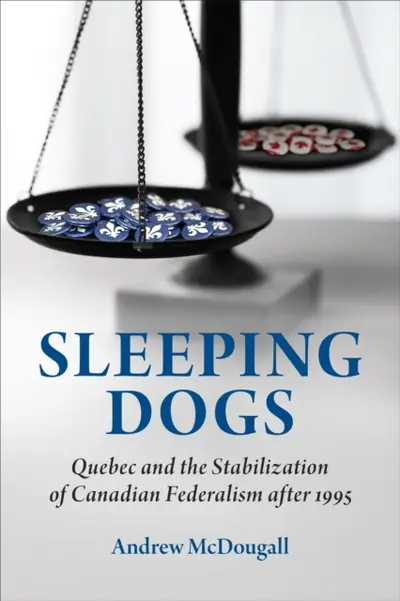
Sleeping Dogs
Quebec and the Stabilization of Canadian Federalism after 1995
Price and availability
$29.99
Available in: Andorra, Austria, Australia, Belgium, Bulgaria, Canada, Switzerland, Cyprus, Czechia, Germany, Denmark, Estonia, Spain, Finland, France, United Kingdom, Guernsey, Greece, Croatia, Hungary, Ireland, Isle of Man, Iceland, Italy, Jersey, Japan, Liechtenstein, Lithuania, Luxembourg, Latvia, Monaco, Malta, Netherlands, Norway, Poland, Portugal, Romania, Sweden, Slovenia, Slovakia, San Marino, United States, Vatican City, South Africa
Stores: US, UK, Canada, EU, Australia.
Sign in to buyThe price is re-checked by the server before payment.
For personal use under the eBook licence.
- Format
- DRM
- Not stated by the publisher
- Language
- English
- Publisher
- University of Toronto Press
- Published
- 31 August 2023
- Pages
- 210
- ISBN
- 9781487516376
- Subjects
- Canada, Quebec, Social issues & processes, Political structure & processes, Political parties, Public administration, Public opinion & polls, Political corruption, Canada, 1KBC-CA-Q, JBF, Political structure and processes, Political parties and party platforms, Public administration / Public policy, JPWA, Corruption in politics, government and society
About this book
What happened to the Quebec sovereignty movement after 1995? In Sleeping Dogs, Andrew McDougall reveals how a change in federalist strategy, combined with an improving political context, helped Canada stabilize its federal system and bury the "e;Quebec question"e; for the foreseeable future. The book identifies five potential reasons the Quebec sovereignty movement lost momentum and argues that all contributed to a political environment that benefited federalists. McDougall explores topics of elite accommodation, generational change, changing identity politics, economic globalization, and constitutional fatigue. He argues that Canada's federalist political elites have capitalized on these developments to stabilize the country by dropping the national question - even when they might still hold very different visions of the Constitution. Building on "e;constitutional abeyance"e; theory, the author conceives of this strategic change as the restoration of a constitutional abeyance among federalist actors. Considering recent history in light of subsequent developments, Sleeping Dogs is a timely and important attempt to understand the evolving situation in Quebec and Canadian federalism.
Bibliographic data © Gardners Books Ltd.