PDF · English
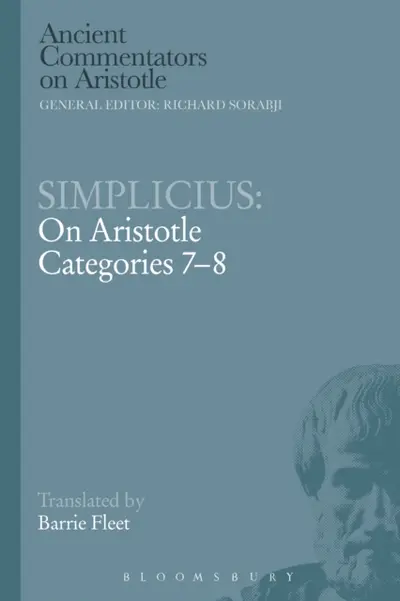
Simplicius: On Aristotle Categories 7-8
Price and availability
$47.99
Available in: Andorra, Austria, Australia, Belgium, Bulgaria, Canada, Switzerland, Cyprus, Czechia, Germany, Denmark, Estonia, Spain, Finland, France, United Kingdom, Guernsey, Greece, Croatia, Hungary, Ireland, Isle of Man, Iceland, Italy, Jersey, Japan, Liechtenstein, Lithuania, Luxembourg, Latvia, Monaco, Malta, Netherlands, Norway, Poland, Portugal, Romania, Sweden, Slovenia, Slovakia, San Marino, United States, Vatican City, South Africa
Stores: US, UK, Canada, EU, Australia.
Sign in to buyThe price is re-checked by the server before payment.
For personal use under the eBook licence.
- Format
- DRM
- Not stated by the publisher
- Language
- English
- Publisher
- Bloomsbury Publishing
- Published
- 10 April 2014
- Pages
- 240
- ISBN
- 9781472501011
- Subjects
- Western philosophy: Ancient, to c 500, QDHA
About this book
In Categories chapters 7 and 8 Aristotle considers his third and fourth categories - those of Relative and Quality. Critics of Aristotle had suggested for each of the non-substance categories that they could really be reduced to relatives, so it is important how the category of Relative is defined. Aristotle offers two definitions, and the second, stricter, one is often cited by his defenders in order to rule out objections. The second definition of relative involves the idea of something changing its relationship through a change undergone by its correlate, not by itself. There were disagreements as to whether this was genuine change, and Plotinus discussed whether relatives exist only in the mind, without being real. The terms used by Aristotle for such relationships was 'being disposed relatively to something', a term later borrowed by the Stoics for their fourth category, and perhaps originating in Plato's Academy. In his discussion of Quality, Aristotle reports a debate on whether justice admits of degrees, or whether only the possession of justice does so. Simplicius reports the further development of this controversy in terms of whether justice admits a range or latitude (platos). This debate helped to inspire the medieval idea of latitude of forms, which goes back much further than is commonly recognised - at least to Plato and Aristotle.
Bibliographic data © Gardners Books Ltd.