PDF · English
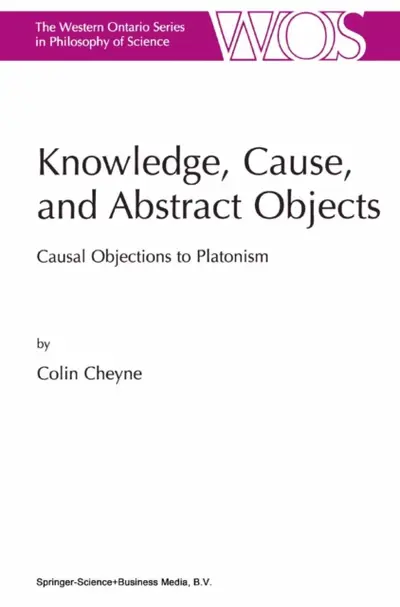
Knowledge, Cause, and Abstract Objects
Causal Objections to Platonism
Price and availability
$120.99
Available in: Andorra, Austria, Australia, Belgium, Bulgaria, Canada, Switzerland, Cyprus, Czechia, Germany, Denmark, Estonia, Spain, Finland, France, United Kingdom, Guernsey, Greece, Croatia, Hungary, Ireland, Isle of Man, Iceland, Italy, Jersey, Japan, Liechtenstein, Lithuania, Luxembourg, Latvia, Monaco, Malta, Netherlands, Norway, Poland, Portugal, Romania, Sweden, Slovenia, Slovakia, San Marino, United States, Vatican City, South Africa
Stores: US, UK, Canada, EU, Australia.
Sign in to buyThe price is re-checked by the server before payment.
For personal use under the eBook licence.
- Format
- DRM
- Not stated by the publisher
- Language
- English
- Publisher
- Springer Netherlands
- Published
- 14 March 2013
- ISBN
- 9789401597470
- Subjects
- Philosophy, Philosophy: metaphysics & ontology, Philosophy: epistemology & theory of knowledge, Jurisprudence & general issues, Jurisprudence & philosophy of law, Philosophy of science, Methods, theory and philosophy of law, Philosophy of science, Philosophy: metaphysics and ontology, Philosophy: epistemology and theory of knowledge
About this book
According to platonists, entities such as numbers, sets, propositions and properties are abstract objects. But abstract objects lack causal powers and a location in space and time, so how could we ever come to know of the existence of such impotent and remote objects? In Knowledge, Cause, and Abstract Objects, Colin Cheyne presents the first systematic and detailed account of this epistemological objection to the platonist doctrine that abstract objects exist and can be known. Since mathematics has such a central role in the acquisition of scientific knowledge, he concentrates on mathematical platonism. He also concentrates on our knowledge of what exists, and argues for a causal constraint on such existential knowledge. Finally, he exposes the weaknesses of recent attempts by platonists to account for our supposed platonic knowledge. This book will be of particular interest to researchers and advanced students of epistemology and of the philosophy of mathematics and science. It will also be of interest to all philosophers with a general interest in metaphysics and ontology.
Bibliographic data © Gardners Books Ltd.