PDF · English
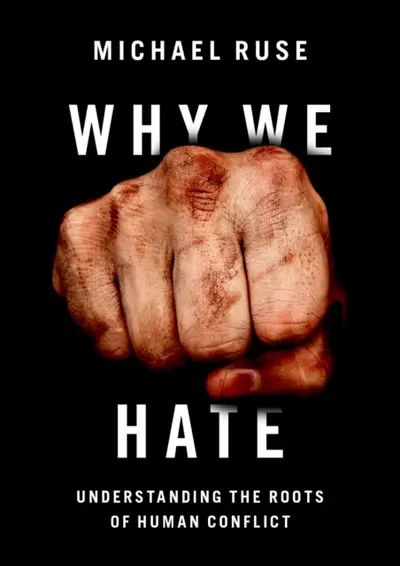
Why We Hate
Understanding the Roots of Human Conflict
Price and availability
$18.99
Available in: Andorra, Austria, Australia, Belgium, Bulgaria, Canada, Switzerland, Cyprus, Czechia, Germany, Denmark, Estonia, Spain, Finland, France, United Kingdom, Guernsey, Greece, Croatia, Hungary, Ireland, Isle of Man, Iceland, Italy, Jersey, Japan, Liechtenstein, Lithuania, Luxembourg, Latvia, Monaco, Malta, Netherlands, Norway, Poland, Portugal, Romania, Sweden, Slovenia, Slovakia, San Marino, United States, Vatican City, South Africa
Stores: US, UK, Canada, EU, Australia.
Sign in to buyThe price is re-checked by the server before payment.
For personal use under the eBook licence.
- Format
- DRM
- Not stated by the publisher
- Language
- English
- Publisher
- Oxford University Press
- Published
- 20 May 2022
- ISBN
- 9780197621295
- Subjects
- Ethics & moral philosophy, Social & political philosophy, Popular philosophy, QDTQ, QDTS, QDX
About this book
An insightful and probing exploration of the contradiction between humans' enormous capacity for hatred and their evolutionary development as a social species Why We Hate tackles a pressing issue of both longstanding interest and fresh relevance: why a social species like Homo sapiens should nevertheless be so hateful to itself. We go to war and are prejudiced against our fellow human beings. We discriminate on the basis of nationality, class, race, sexual orientation, religion, and gender. Why are humans at once so social and so hateful to each other? In this book, prominent philosopher Michael Ruse looks at scientific understandings of human hatred, particularly Darwinian evolutionary theory. He finds the secret to this paradox in our tribal evolutionary past, when we moved ten thousand years ago from being hunter-gatherers to agriculturalists--a shift that paved the way for modern civilization. Simply put, as Ruse paraphrases, "e;our modern skulls house Stone Age minds."e; Combining rigorous argument with an engaging and accessible style, Ruse makes frequent use of historical examples, examining the history of two World Wars, and the U.S. offensive against Iraq. He also gives many pertinent and up-to-date examples of prejudice, including the significance of Brexit and the systemic racism that lead to the Black Lives Matter movement. Ruse pays special attention to egregious cases of hatred, such as the treatment of Jews by the Third Reich, and to pressing contemporary issues, including the status of women. Ruse concludes with constructive suggestions for ways in which we might reconcile the contradictory aspects of our nature. Why We Hate will be of interest and value to a wide range of readers interested in the role of human nature in current events, as well as to readers interested in philosophy, the life sciences, social sciences (especially anthropology and archaeology), and beyond.
Bibliographic data © Gardners Books Ltd.