PDF · English
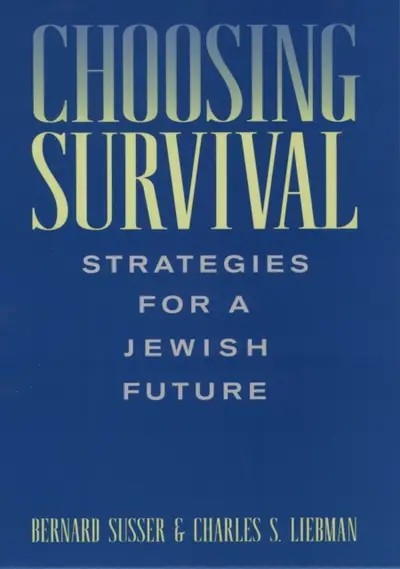
Choosing Survival
Strategies for a Jewish Future
Price and availability
$21.99
Available in: Andorra, Austria, Australia, Belgium, Bulgaria, Canada, Switzerland, Cyprus, Czechia, Germany, Denmark, Estonia, Spain, Finland, France, United Kingdom, Guernsey, Greece, Croatia, Hungary, Ireland, Isle of Man, Iceland, Italy, Jersey, Japan, Liechtenstein, Lithuania, Luxembourg, Latvia, Monaco, Malta, Netherlands, Norway, Poland, Portugal, Romania, Sweden, Slovenia, Slovakia, San Marino, United States, Vatican City, South Africa
Stores: US, UK, Canada, EU, Australia.
Sign in to buyThe price is re-checked by the server before payment.
For personal use under the eBook licence.
- Format
- DRM
- Not stated by the publisher
- Language
- English
- Publisher
- Oxford University Press
- Published
- 24 June 1999
- ISBN
- 9780198029342
- Subjects
- Judaism, Ethnic studies, JBSL, QRJ
About this book
Throughout history, the persecutions of the Jewish people have been central to their identity and to the cohesion of their religion and cultural heritage. But now, with the success of the Jewish State of Israel and the prosperity of Jews in the United States, the collective sufferings that have forged the Jewish identity are disappearing. The compelling question Bernard Susser and Charles Liebman ask in Choosing Survival is: Will this success paradoxically prove fatal to Judaism? Susser and Liebman paint a disturbing portrait of the decline of Judaism in both Israel and the United States and the various--and mainly ineffective--efforts to reverse that decline. In Israel, as Jews are increasingly drawn to cosmopolitan Western culture, Jewishness is in danger of being reduced merely to communal folkways, while political tensions between religious and secular Jews threaten to pull the state apart. In the U.S., assimilation and secularization is even harder to resist. Efforts to strengthen Jewish identity by claiming the U.S. is still anti-Semitic and by pointing to the Holocaust and the threats to Israel's survival have not worked. The authors do, however, see a hopeful sign in Jewish Orthodoxy which, while not a viable solution to the problem, is successfully passing on its tenets and practices and attracting many non-Orthodox Jews. They identify several aspects of Orthodoxy that can be emulated by all Jews and hold the best hope for Jewish survival--its reverence for study, its ability to set and maintain boundaries, and its deep belief in community. For anyone concerned about the fate of Judaism and what it means to be Jewish, Choosing Survival is an impassioned, troubling, and essential book.
Bibliographic data © Gardners Books Ltd.