EPUB · English
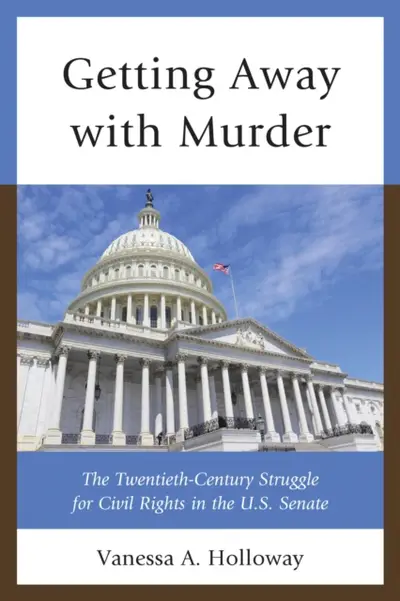
Getting Away with Murder
The Twentieth-Century Struggle for Civil Rights in the U.S. Senate
Price and availability
$43.99
Available in: Andorra, Austria, Australia, Belgium, Bulgaria, Canada, Switzerland, Cyprus, Czechia, Germany, Denmark, Estonia, Spain, Finland, France, United Kingdom, Guernsey, Greece, Croatia, Hungary, Ireland, Isle of Man, Iceland, Italy, Jersey, Japan, Liechtenstein, Lithuania, Luxembourg, Latvia, Monaco, Malta, Netherlands, Norway, Poland, Portugal, Romania, Sweden, Slovenia, Slovakia, San Marino, United States, Vatican City, South Africa
Stores: US, UK, Canada, EU, Australia.
Sign in to buyThe price is re-checked by the server before payment.
For personal use under the eBook licence.
- Format
- EPUB
- DRM
- Not stated by the publisher
- Language
- English
- Publisher
- Bloomsbury Publishing (USA)
- Published
- 15 December 2014
- Pages
- 134
- ISBN
- 9780761864332
- Subjects
- USA, 20th century, Violence in society, Social discrimination & inequality, Rural communities, Ethnic studies, Black & Asian studies, Crime & criminology, Central government policies, Civil rights & citizenship, United States of America, USA, 3MP, JBFA, JBFK, JBSC, JBSL, Crime and criminology, Central / national / federal government policies, JPVC
About this book
Throughout the late nineteenth and early twentieth century, the U.S. Congress engaged in bitter debates on whether to enact a federal law that would prosecute private citizens who lynched black Americans. In Getting Away with Murder, the fundamental question under scrutiny is whether Southern Democrats' racist attitudes toward black Americans pardoned the atrocities of lynching. The book investigates underlying motives of opposition to Senate filibustering and invites an intellectual discussion on why Southern Democrats thought states' rights were the remedy to lynching, when, in fact, the phenomenon was a baffling national crisis. A rebuttal to this query may include notions that congressional investigations into state-protected rights were deemed unconstitutional. In a unifying theme, the appeal ties into questions of the federalism-civil rights debate by noting intervals that warrant research and advancing new perspectives intended to accentuate the matrices of race-based politics. To examine the federalism-civil rights debate, this book asks three practical questions: (1) Would Southern Democrats suspend their friendships with private citizens and enact a federal law that would prosecute them for lynching? (2) Was the national government limited in its constitutional power to protect black Americans from private citizens who organized themselves as lynch mobs? (3) Were concerns for states' rights the core reasons for Senate filibustering, or did Southern Democrats' argument for states' rights support the lie of racism?
Bibliographic data © Gardners Books Ltd.