PDF · English
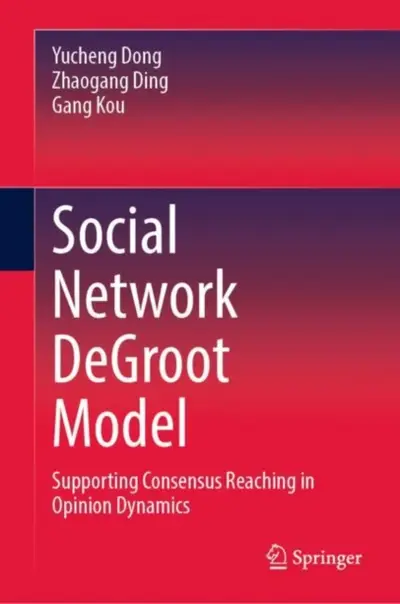
Social Network DeGroot Model
Supporting Consensus Reaching in Opinion Dynamics
Price and availability
$148.99
Available in: Andorra, Austria, Australia, Belgium, Bulgaria, Canada, Switzerland, Cyprus, Czechia, Germany, Denmark, Estonia, Spain, Finland, France, United Kingdom, Guernsey, Greece, Croatia, Hungary, Ireland, Isle of Man, Iceland, Italy, Jersey, Japan, Liechtenstein, Lithuania, Luxembourg, Latvia, Monaco, Malta, Netherlands, Norway, Poland, Portugal, Romania, Sweden, Slovenia, Slovakia, San Marino, United States, Vatican City, South Africa
Stores: US, UK, Canada, EU, Australia.
Sign in to buyThe price is re-checked by the server before payment.
For personal use under the eBook licence.
- Format
- DRM
- Not stated by the publisher
- Language
- English
- Publisher
- Springer Nature Singapore
- Published
- 27 April 2024
- ISBN
- 9789819704217
- Subjects
- Communication studies, Sociology, Social, group or collective psychology, Business communication & presentation, Communication studies, Sociology, Social, group or collective psychology, Business communication, etiquette and presentation
About this book
This book investigates the DeGroot model in social network contexts, and proposes the social network DeGroot (SNDG) model. Specifically, this book focuses on two core research problems in the SNDG model: (i) Social network structures to reach a stable state (consensus, polarization, or fragmentation); and (ii) the convergence rate to reach a stable state. Furthermore, the authors generalize the SNDG model in an uncertain context, showing the effects of interval opinions on the SNDG model. In this book, the authors also discuss the applications of the SNDG model to support group decision making, including consensus reaching through adding minimum interactions, trust relationships manipulations, and risk control issues in the social network. Apart from theoretical analysis, detailed experimental simulations with real and random data will be applied to validate our research.This book is the first to connect opinion dynamics, social network and group decision making. The resultsreported can help us understand the evolution of public opinions in social network contexts and provide new tools to support consensus reaching in group decision making.
Bibliographic data © Gardners Books Ltd.