EPUB · English
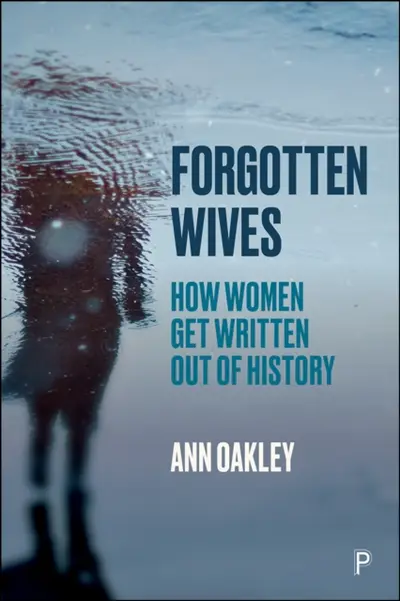
Forgotten Wives
How Women Get Written Out of History
Price and availability
Price unavailable
Available in: Andorra, Austria, Australia, Belgium, Bulgaria, Canada, Switzerland, Cyprus, Czechia, Germany, Denmark, Estonia, Spain, Finland, France, United Kingdom, Guernsey, Greece, Croatia, Hungary, Ireland, Isle of Man, Iceland, Italy, Jersey, Japan, Liechtenstein, Lithuania, Luxembourg, Latvia, Monaco, Malta, Netherlands, Norway, Poland, Portugal, Romania, Sweden, Slovenia, Slovakia, San Marino, United States, Vatican City, South Africa
Stores: US, UK, Canada, EU, Australia.
This title cannot be bought in this store yet: its supplier terms, territorial rights or price are still being confirmed.
For personal use under the eBook licence.
- Format
- EPUB
- DRM
- Not stated by the publisher
- Language
- English
- Publisher
- Policy Press
- Published
- 6 July 2021
- Pages
- 256
- ISBN
- 9781447355861
- Subjects
- Social discrimination & inequality, Feminism & feminist theory, Gender studies: women, Social discrimination and social justice, Gender studies: women and girls, Feminism and feminist theory
About this book
Throughout history, records of women's lives and work have been lost through the pervasive assumption of male dominance. Wives, especially, disappear as supporters of their husbands' work, as unpaid and often unacknowledged secretaries and research assistants, and as managers of men's domestic domains; even intellectual collaboration tends to be portrayed as normative wifely behaviour rather than as joint work.Forgotten Wives examines the ways in which the institution and status of marriage has contributed to the active disremembering of women s achievements. Drawing on archives, biographies, autobiographies and historical accounts, best-selling author and academic Ann Oakley interrogates conventions of history and biography-writing using the case studies of four women married to well-known men Charlotte Shaw, Mary Booth, Jeannette Tawney and Janet Beveridge. Asking critical questions about the mechanisms that maintain gender inequality, despite thriving feminist and other equal rights movements, she contributes a fresh vision of how the welfare state developed in the early 20th century.
Bibliographic data © Gardners Books Ltd.