PDF · German
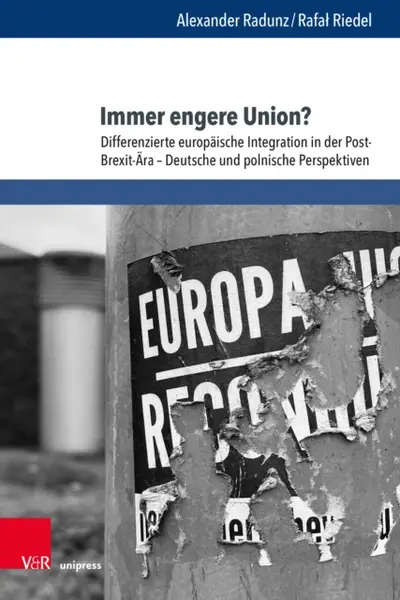
Immer engere Union?
Differenzierte europäische Integration in der Post-Brexit-Ära – Deutsche und polnische Perspektiven
Price and availability
$54.99
Available in: Andorra, Austria, Australia, Belgium, Bulgaria, Canada, Switzerland, Cyprus, Czechia, Germany, Denmark, Estonia, Spain, Finland, France, United Kingdom, Guernsey, Greece, Croatia, Hungary, Ireland, Isle of Man, Iceland, Italy, Jersey, Japan, Liechtenstein, Lithuania, Luxembourg, Latvia, Monaco, Malta, Netherlands, Norway, Poland, Portugal, Romania, Sweden, Slovenia, Slovakia, San Marino, United States, Vatican City, South Africa
Stores: US, UK, Canada, EU, Australia.
Sign in to buyThe price is re-checked by the server before payment.
For personal use under the eBook licence.
- Format
- DRM
- Not stated by the publisher
- Language
- German
- Publisher
- Brill Deutschland GmbH
- Published
- 9 October 2023
- ISBN
- 9783847016342
- Subjects
- Social issues & processes, Comparative politics, Germany, Poland, EU (European Union), Social or cultural Integration and assimilation, Comparative politics
About this book
Dieses Buch bietet neue Einblicke in den aktuellen Stand der differenzierten Integration in Europa aus der Perspektive Deutschlands, repräsentativ für den inneren Kern der Europäischen Union, und Polens, welches die Semiperipherie vertritt. Als theoretisches Vehikel nutzen die Autoren die innerstaatlichen und transnationalen Konfliktlinien (Cleavages), die durch die kumulativen Krisen der europäischen Integration hervortreten. Sie untersuchen, wie diese die differenzierten Einstellungen von Bürgern und Parteien gegenüber der europäischen Integration in Europa beeinflussen. Folglich liefert dieses Buch eine kohärente interdisziplinäre Studie, welche die klassischen politikwissenschaftlichen Theorien mit den großen Debatten der europäischen Integrationsliteratur verbindet.This book offers new insights in recent developments in differentiated integration in Europe from the perspective of Germany, representing the inner core of the European Union, and Poland representing the semi-periphery. The authors use the intranational and transnational cleavages which came along with the cumulative crises of the European integration as a theoretical vehicle. They analyse how these crises influence the different positions of citizens and parties in the European Union towards the European integration. Thus, this book provides a coherent interdisciplinary study which connects the classic political theories with the great debates of the European integration literature.
Bibliographic data © Gardners Books Ltd.