PDF · English
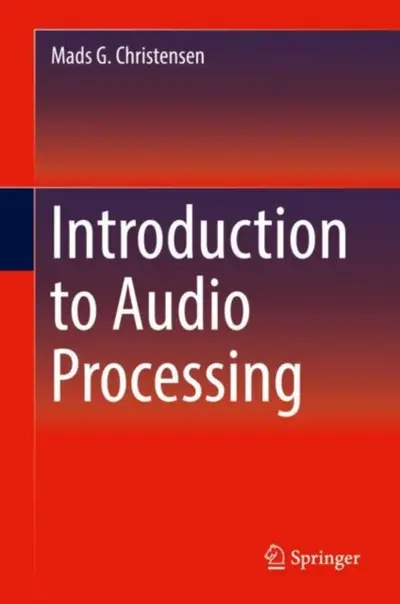
Introduction to Audio Processing
Price and availability
$94.99
Available in: Andorra, Austria, Australia, Belgium, Bulgaria, Canada, Switzerland, Cyprus, Czechia, Germany, Denmark, Estonia, Spain, Finland, France, United Kingdom, Guernsey, Greece, Croatia, Hungary, Ireland, Isle of Man, Iceland, Italy, Jersey, Japan, Liechtenstein, Lithuania, Luxembourg, Latvia, Monaco, Malta, Netherlands, Norway, Poland, Portugal, Romania, Sweden, Slovenia, Slovakia, San Marino, United States, Vatican City, South Africa
Stores: US, UK, Canada, EU, Australia.
Sign in to buyThe price is re-checked by the server before payment.
For personal use under the eBook licence.
- Format
- DRM
- Not stated by the publisher
- Language
- English
- Publisher
- Springer International Publishing
- Published
- 30 March 2019
- ISBN
- 9783030117818
- Subjects
- Acoustic & sound engineering, Signal processing, Audio processing, Electronics engineering, Acoustic and sound engineering, Computer applications in the social and behavioural sciences, Digital signal processing (DSP), Human–computer interaction
About this book
This textbook presents an introduction to signal processing for audio applications. The author's approach posits that math is at the heart of audio processing and that it should not be simplified. He thus retains math as the core of signal processing and includes concepts of difference equations, convolution, and the Fourier Transform. Each of these is presented in a context where they make sense to the student and can readily be applied to build artifacts. Each chapter in the book builds on the previous ones, building a linear, coherent story. The book starts with a definition of sound and goes on to discuss digital audio signals, filters, The Fourier Transform, audio effects, spatial effects, audio equalizers, dynamic range control, and pitch estimation. The exercises in each chapter cover the application of the concepts to audio signals. The exercises are made specifically for Pure Data (Pd) although traditional software, such as MATLAB, can be used. The book is intended for students in media technology bachelor programs. The book is based on material the author developed teaching on the topic over a number of years.
Bibliographic data © Gardners Books Ltd.