PDF · English
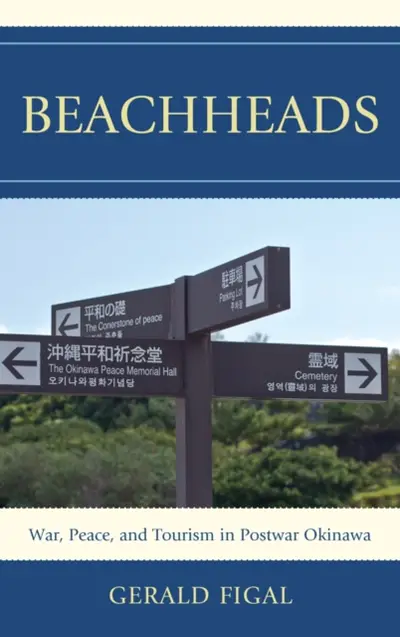
Beachheads
War, Peace, and Tourism in Postwar Okinawa
Price and availability
$52.99
Available in: Andorra, Austria, Australia, Belgium, Bulgaria, Canada, Switzerland, Cyprus, Czechia, Germany, Denmark, Estonia, Spain, Finland, France, United Kingdom, Guernsey, Greece, Croatia, Hungary, Ireland, Isle of Man, Iceland, Italy, Jersey, Japan, Liechtenstein, Lithuania, Luxembourg, Latvia, Monaco, Malta, Netherlands, Norway, Poland, Portugal, Romania, Sweden, Slovenia, Slovakia, San Marino, United States, Vatican City, South Africa
Stores: US, UK, Canada, EU, Australia.
Sign in to buyThe price is re-checked by the server before payment.
For personal use under the eBook licence.
- Format
- DRM
- Not stated by the publisher
- Language
- English
- Publisher
- Bloomsbury Publishing (USA)
- Published
- 12 April 2012
- Pages
- 276
- ISBN
- 9781442215832
- Subjects
- Japan, c 1945 to c 2000 (Post-war period), Peace studies & conflict resolution, Asian history, Postwar 20th century history, from c 1945 to c 2000, Second World War, International relations, Warfare & defence, Tourism industry, 3MPQ, GTU, International relations, Warfare and defence, Hospitality, sports, leisure and tourism industries, NH, NHF, NHWR7
About this book
This original and fresh book explores Okinawa's makeover as a tourist mecca in the long historical shadow and among the physical ruins of the Pacific War's most devastating land battle. Gerald Figal considers how a place burdened by a history of semicolonialism, memories of war and occupation, economic hardship, and contentious current political affairs has reshaped itself into a resort destination. Drawing on an innovative mix of detailed archival research and extensive fieldwork, Gerald Figal considers the ways Okinawa has accommodated war experience and its legacies within the manufacture and promotion of both a "e;tropical paradise"e; image and a heritage tourism site identified with the premodern Ryukyu Kingdom. Tracing the postwar formation of "e;Tourist Okinawa,"e; Figal addresses interrelated issues of economic sustainability, local political autonomy, interregional and international relations, environmental preservation, historical and cultural self-representation, and especially Okinawa's role as a global peace site laboring under the legacies of war. From the end of World War Two to the present, the author follows Okinawa's evolution through three main themes: war memorialization, tourism-influenced environmental and historical restoration, and invasion and occupation represented by U.S. military bases and beach resorts. Creatively, accessibly, and eloquently written, this compelling work highlights a set of islands that represent key issues facing contemporary Japan.
Bibliographic data © Gardners Books Ltd.