PDF · English
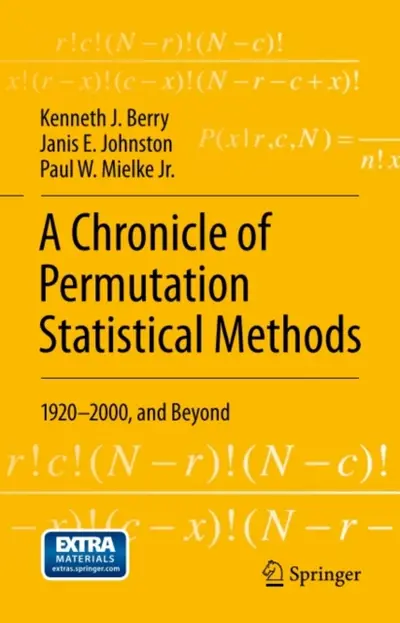
Chronicle of Permutation Statistical Methods
1920–2000, and Beyond
Price and availability
$120.99
Available in: Andorra, Austria, Australia, Belgium, Bulgaria, Canada, Switzerland, Cyprus, Czechia, Germany, Denmark, Estonia, Spain, Finland, France, United Kingdom, Guernsey, Greece, Croatia, Hungary, Ireland, Isle of Man, Iceland, Italy, Jersey, Japan, Liechtenstein, Lithuania, Luxembourg, Latvia, Monaco, Malta, Netherlands, Norway, Poland, Portugal, Romania, Sweden, Slovenia, Slovakia, San Marino, United States, Vatican City, South Africa
Stores: US, UK, Canada, EU, Australia.
Sign in to buyThe price is re-checked by the server before payment.
For personal use under the eBook licence.
- Format
- DRM
- Not stated by the publisher
- Language
- English
- Publisher
- Springer International Publishing
- Published
- 11 April 2014
- ISBN
- 9783319027449
- Subjects
- Probability & statistics, History of mathematics, Probability and statistics, History of mathematics
About this book
The focus of this book is on the birth and historical development of permutation statistical methods from the early 1920s to the near present. Beginning with the seminal contributions of R.A. Fisher, E.J.G. Pitman, and others in the 1920s and 1930s, permutation statistical methods were initially introduced to validate the assumptions of classical statistical methods. Permutation methods have advantages over classical methods in that they are optimal for small data sets and non-random samples, are data-dependent, and are free of distributional assumptions. Permutation probability values may be exact, or estimated via moment- or resampling-approximation procedures. Because permutation methods are inherently computationally-intensive, the evolution of computers and computing technology that made modern permutation methods possible accompanies the historical narrative. Permutation analogs of many well-known statistical tests are presented in a historical context, includingmultiple correlation and regression, analysis of variance, contingency table analysis, and measures of association and agreement. A non-mathematical approach makes the text accessible to readers of all levels.
Bibliographic data © Gardners Books Ltd.