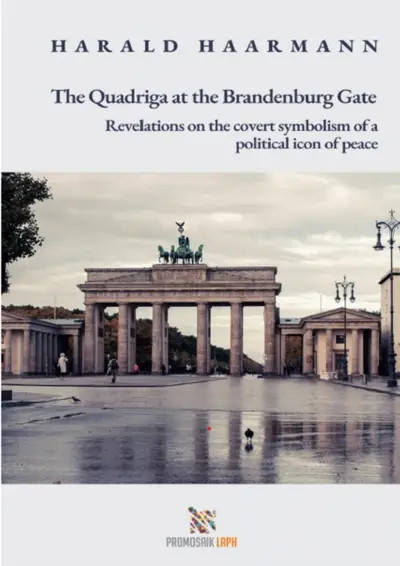
EPUB · English
Quadriga at the Brandenburg Gate
Revelations on the covert symbolism of a political icon of peace
Price and availability
$6.99
Available in: Andorra, Austria, Australia, Belgium, Bulgaria, Canada, Switzerland, Cyprus, Czechia, Germany, Denmark, Estonia, Spain, Finland, France, United Kingdom, Guernsey, Greece, Croatia, Hungary, Ireland, Isle of Man, Iceland, Italy, Jersey, Japan, Liechtenstein, Lithuania, Luxembourg, Latvia, Monaco, Malta, Netherlands, Norway, Poland, Portugal, Romania, Sweden, Slovenia, Slovakia, San Marino, United States, Vatican City, South Africa
Stores: US, UK, Canada, EU, Australia.
Sign in to buyThe price is re-checked by the server before payment.
For personal use under the eBook licence.
- Format
- EPUB
- DRM
- Not stated by the publisher
- Language
- English
- Publisher
- epubli
- Published
- 21 July 2026
- ISBN
- 9783565573882
- Subjects
- Language teaching & learning (other than ELT), Language teaching and learning
About this book
The Brandenburg Gate holds iconic value for Berlin, much like the Eiffel Tower for Paris or Tower Bridge for London. This icon symbolizes peace and political reconciliation in Europe. As a consequence, its image connects to the original function attributed to the monument as a 'Gate of Peace' in the late 18th century. However, the Brandenburg Gate has also served as a political icon of the Prussian nation-state and an expression of Prussian militarism. This contradiction is particularly evident in the changing decoration of the Quadriga, the four-horse chariot made of copper. This study of Prof. Harald Haarmann is the first to interpret and explain this contradictory symbolism at a historical and political level. A female figure from ancient mythology appears as the charioteer, associated with the ceremonial chariot of the Quadriga. Originally, the chariot had no connection to female deities. This connection is an innovation in cultural history, arising in the contact environment where the tradition of an Indo-European warrior caste merged with the cult of goddesses of Old European (i.e., pre-Indo-European) origin. Since such a fusion in early antiquity, women have also been associated with the chariot, concretely as warriors and symbolically in the form of protective goddesses. The Greco-Roman tradition of ancient mythology is familiar to us through the canon of our Western reception history. The other cultural current in Greek 'disguise' is much older than Greek antiquity. It reflects traditions from the pre-Greek cultural epoch. This older tradition of Old European civilization has only been documented through recent research, and the findings are still little known in art history. Harald Haarmann (born 1946) is a renowned German linguist and cultural scientist. Based in Finland, he serves as director of the European branch of the Institute of Archaeomythology. He is widely known for his extensive research on the ancient civilization of Old Europe.
Bibliographic data © Gardners Books Ltd.