EPUB · English
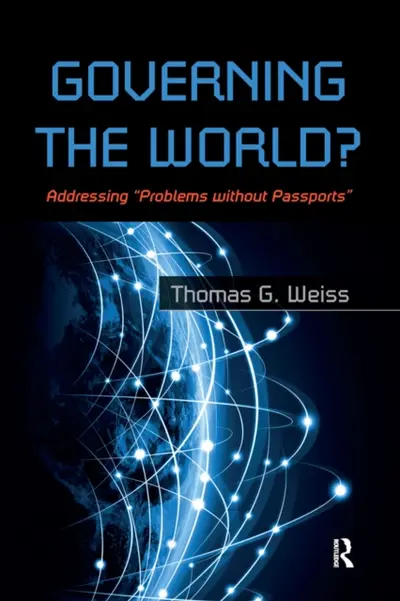
Governing the World?
Addressing "Problems Without Passports"
Price and availability
$59.99
Available in: Andorra, Austria, Australia, Belgium, Bulgaria, Canada, Switzerland, Cyprus, Czechia, Germany, Denmark, Estonia, Spain, Finland, France, United Kingdom, Guernsey, Greece, Croatia, Hungary, Ireland, Isle of Man, Iceland, Italy, Jersey, Japan, Liechtenstein, Lithuania, Luxembourg, Latvia, Monaco, Malta, Netherlands, Norway, Poland, Portugal, Romania, Sweden, Slovenia, Slovakia, San Marino, United States, Vatican City, South Africa
Stores: US, UK, Canada, EU, Australia.
Sign in to buyThe price is re-checked by the server before payment.
For personal use under the eBook licence.
- Format
- EPUB
- DRM
- Not stated by the publisher
- Language
- English
- Publisher
- Taylor & Francis
- Published
- 17 November 2015
- ISBN
- 9781317258629
- Subjects
- International relations, Regional / International studies, International institutions / intergovernmental organizations
About this book
Problems posed by Syria s chemical weapons attacks, Egypt s ouster of an elected government, and myriad other global dilemmas beg the question of whether and how the world can be governed. The challenge is addressing what former UN Secretary-General Kofi Annan called Problems without Passports environmental, economic, humanitarian, and political crises that threaten stability, prosperity, and even human survival. Everything is globalized everything "e;except"e; politics, which remain imprisoned behind national borders. The world has changed, but our basic way of managing it has not. We pursue fitful, tactical, short-term, and local responses for actual or looming threats that require sustained, strategic, longer-run, and global actions. With clarity and passion, Thomas G. Weiss argues for a diversity of organizational arrangements some centralized, some decentralized and a plurality of problem-solving strategies some worldwide, some local. He proposes a three-pronged strategy: the expansion of the formidable amount of practical global governance that already exists, the harnessing of political and economic possibilities opened by the communications revolution, and the recommitment by states to a fundamental revamping of the United Nations."e;
Bibliographic data © Gardners Books Ltd.