PDF · English
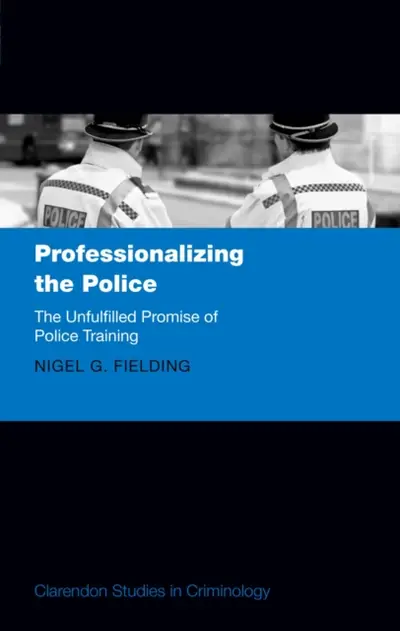
Professionalizing the Police
The Unfulfilled Promise of Police Training
Price and availability
$85.99
Available in: Andorra, Austria, Australia, Belgium, Bulgaria, Canada, Switzerland, Cyprus, Czechia, Germany, Denmark, Estonia, Spain, Finland, France, United Kingdom, Guernsey, Greece, Croatia, Hungary, Ireland, Isle of Man, Iceland, Italy, Jersey, Japan, Liechtenstein, Lithuania, Luxembourg, Latvia, Monaco, Malta, Netherlands, Norway, Poland, Portugal, Romania, Sweden, Slovenia, Slovakia, San Marino, United States, Vatican City, South Africa
Stores: US, UK, Canada, EU, Australia.
Sign in to buyThe price is re-checked by the server before payment.
For personal use under the eBook licence.
- Format
- DRM
- Not stated by the publisher
- Language
- English
- Publisher
- Oxford University Press
- Published
- 8 August 2018
- ISBN
- 9780192549730
- Subjects
- United Kingdom, Great Britain, Police & security services, Crime & criminology, Police law & police procedures, Police and security services, Crime and criminology, Police law and police procedures
About this book
Professionalizing the Police is a timely reassessment of the development of British police training and its contribution to the furtherance of the police professionalism agenda. The police have long struggled with the concept of professionalism. The Victorians veered from regarding police as servants to sanctifying policing as a special calling, while the supposed Golden Age of Policing was riven by divisions of class as sharp as those of the social diversity that poses one of contemporary policing's harshest tests. Police training has reflected these ambiguities and uncertainties. The ground its curriculum covers, pedagogy it employs, and structures through which it operates have been contested, troublesome to manage, and blamed for policing's failures. Behind these frictions lie large issues of governance, policing's place in society and what it means to be professional. Late modernity is marked by uncertainty and scepticism. In 'post-truth' times, professionalism must accommodate ambiguities of class, ethnicity and sexuality. The police languish as last believers in a monochrome vision of society while the norms that make for contemporary sociality have moved on to a multiplex of diversities that harbour new extremes both of tolerance and intolerance. True professionalism alerts practitioners to other ways of delivering social control and just societies: empowering citizens and encouraging autonomy; supporting new modes of social relationships and lifestyle; fitting provision to cases; pluralizing services. This yardstick is used to assess and challenge the recruit and in-service curriculum and to tease out the options around which professionalism can be configured and embedded such that it plays its part in a humane, coherent, and accountable framework of police governance. The book will appeal to academics and postgraduate students in police research (across criminology, sociology, psychology, socio-legal studies) and the professions (sociology, political science), as well as senior police managers and trainers in the police service and other applied government bodies.
Bibliographic data © Gardners Books Ltd.