PDF · English
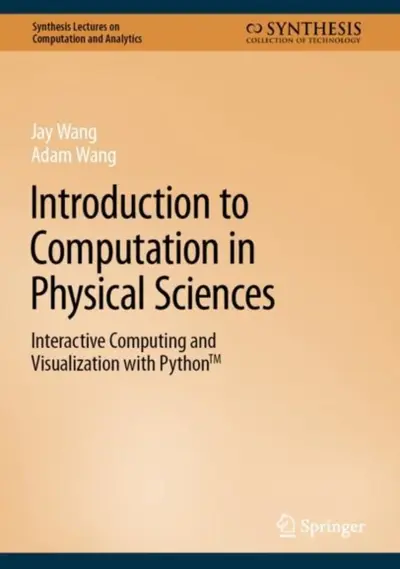
Introduction to Computation in Physical Sciences
Interactive Computing and Visualization with Python™
Price and availability
$60.99
Available in: Andorra, Austria, Australia, Belgium, Bulgaria, Canada, Switzerland, Cyprus, Czechia, Germany, Denmark, Estonia, Spain, Finland, France, United Kingdom, Guernsey, Greece, Croatia, Hungary, Ireland, Isle of Man, Iceland, Italy, Jersey, Japan, Liechtenstein, Lithuania, Luxembourg, Latvia, Monaco, Malta, Netherlands, Norway, Poland, Portugal, Romania, Sweden, Slovenia, Slovakia, San Marino, United States, Vatican City, South Africa
Stores: US, UK, Canada, EU, Australia.
Sign in to buyThe price is re-checked by the server before payment.
For personal use under the eBook licence.
- Format
- DRM
- Not stated by the publisher
- Language
- English
- Publisher
- Springer International Publishing
- Published
- 25 January 2023
- ISBN
- 9783031176463
- Subjects
- Mathematics, Numerical analysis, Applied mathematics, Mathematical physics, Computer programming / software development, Programming & scripting languages: general, Computer science, Maths for computer scientists, Information visualization, Numerical analysis, Mathematical / Computational / Theoretical physics, Computer programming / software engineering, Programming and scripting languages: general, Maths for computer scientists, Information visualization
About this book
This book provides a practical and comprehensive introduction to computational problem solving from the viewpoints of practitioners in both academic and industrial worlds. The authors present scientific problem-solving using computation and aim to increase computational thinking, which is the mindset and skillset required to solve scientific problems with computational methodologies via model building, simulation, data analysis, and visualization using the Python programming language. Topics and examples span fundamental areas of physical science as well as contemporary topics including quantum computing, neural networks, machine learning, global warming, and energy balance. The book features unique and innovative techniques and practices including: intentional scaffolding to help beginners learn computational problem solving; multimodal computing environments including cloud-based platforms and just-in-time computing; emphasis and connection between both numerical and symbolic computations; and extensive exercise sets carefully designed for further exploration as project assignments or self-paced study. The book is suitable for introductory level readers in physical sciences, engineering, and related STEM disciplines. Specifically, the book is appropriate for use in either a standalone course on computation and modeling and as a resource for readers interested in learning about proven techniques in interactive computing.
Bibliographic data © Gardners Books Ltd.