EPUB · English
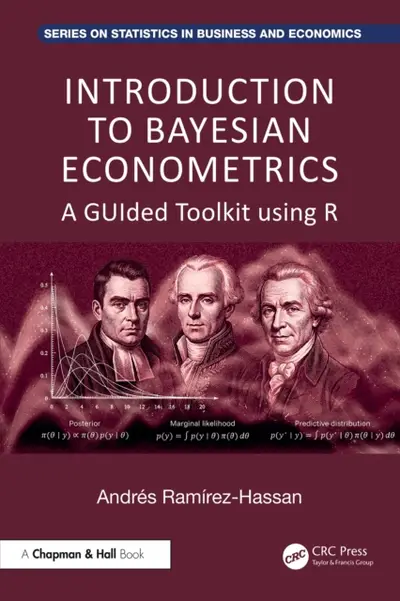
Introduction to Bayesian Econometrics
A GUIded Toolkit using R
Price and availability
$105.99
Available in: Andorra, Austria, Australia, Belgium, Bulgaria, Canada, Switzerland, Cyprus, Czechia, Germany, Denmark, Estonia, Spain, Finland, France, United Kingdom, Guernsey, Greece, Croatia, Hungary, Ireland, Isle of Man, Iceland, Italy, Jersey, Japan, Liechtenstein, Lithuania, Luxembourg, Latvia, Monaco, Malta, Netherlands, Norway, Poland, Portugal, Romania, Sweden, Slovenia, Slovakia, San Marino, United States, Vatican City, South Africa
Stores: US, UK, Canada, EU, Australia.
Sign in to buyThe price is re-checked by the server before payment.
For personal use under the eBook licence.
- Format
- EPUB
- DRM
- Not stated by the publisher
- Language
- English
- Publisher
- CRC Press
- Published
- 31 July 2026
- ISBN
- 9781040711590
- Subjects
- Econometrics, Economic statistics, Probability & statistics, Econometrics and economic statistics, Probability and statistics
About this book
Introduction to Bayesian Econometrics: A GUIded Toolkit Using R offers a practical, conceptually clear, and computationally accessible pathway into Bayesian data analysis. Designed for readers who wish to apply Bayesian methods without necessarily investing years in programming, the book combines rigorous treatment of foundational ideas with a graphical user interface (GUI) that allows users to run Bayesian regression models in a user-friendly environment.The first part develops the mathematical foundations of Bayesian inference by presenting all derivations step-by-step. This transparent treatment of conjugate models, including posterior analysis, marginal likelihoods, and posterior predictive distributions, provides readers with a strong theoretical base for the more advanced material that follows.The second part focuses on implementation. It introduces the custom GUI for readers with little or no programming experience, demonstrates how to fit Bayesian models using established R packages, and guides more advanced users through programming key components of Bayesian samplers from scratch. This integrated approach enables readers with different backgrounds to engage with Bayesian methods at their preferred level of computational depth.The third part extends the framework to modern Bayesian econometrics. It covers Bayesian machine learning, causal inference, and approximate methods, illustrating how Bayesian ideas can be applied to contemporary empirical challenges. By combining theory, software, and hands-on computation, the book provides a comprehensive entry point into both classical and modern Bayesian analysis.Across all parts, the book is designed to support a wide range of users -beginners, intermediate programmers, and advanced learners-. To the best of the author's knowledge, no existing text combines mathematical transparency, software accessibility, and modern Bayesian topics in a single, integrated resource.
Bibliographic data © Gardners Books Ltd.