PDF · English
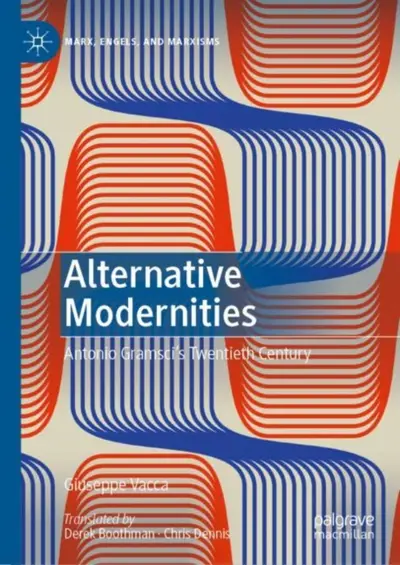
Alternative Modernities
Antonio Gramsci''s Twentieth Century
Price and availability
$120.99
Available in: Andorra, Austria, Australia, Belgium, Bulgaria, Canada, Switzerland, Cyprus, Czechia, Germany, Denmark, Estonia, Spain, Finland, France, United Kingdom, Guernsey, Greece, Croatia, Hungary, Ireland, Isle of Man, Iceland, Italy, Jersey, Japan, Liechtenstein, Lithuania, Luxembourg, Latvia, Monaco, Malta, Netherlands, Norway, Poland, Portugal, Romania, Sweden, Slovenia, Slovakia, San Marino, United States, Vatican City, South Africa
Stores: US, UK, Canada, EU, Australia.
Sign in to buyThe price is re-checked by the server before payment.
For personal use under the eBook licence.
- Format
- DRM
- Not stated by the publisher
- Language
- English
- Publisher
- Springer International Publishing
- Published
- 23 October 2020
- ISBN
- 9783030476717
- Subjects
- Social & political philosophy, Sociology, Politics & government, Political science & theory, Sociology, Politics and government, Political science and theory, Social and political philosophy
About this book
Antonio Gramsci lived the Great War as a "e;historic break,"e; a profound experience that left an indelible mark on the development of his political thought. Translated into English for the first time, Alternative Modernities reconstructs and analyses this critical period of Gramsci's intellectual formation through a systematic analysis of his writings from 1915 to 1935. For Gramsci, Soviet Communism, "e;Americanism,"e; and the "e;new"e; Fascist State were the principle responses to the crisis of the old world order. He portrayed them as the three protagonists of twentieth-century modernity, alternatives destined to tragically clash in the worldwide struggle for hegemony. Among the arguments in his Prison Notebooks, Gramsci casts doubt on the political strategy of Soviet Communism and the theoretical underpinnings of "e;official Marxism."e; Instead, he suggests a radical revision of Marxism by breathing life into a new interpretation whose fundamental concepts are: politics as the struggle for hegemony, the "e;passive revolution"e; as a historical paradigm of modernity, and the philosophy of praxis as the welding between visions of the worlds, historical analyses, and political strategies. Gramsci's intuitions culminate in a new theory of the political subject, supported by a reflection upon the 20th century that still speaks to us today, pointing the way toward a new narrative of world history.
Bibliographic data © Gardners Books Ltd.