PDF · English
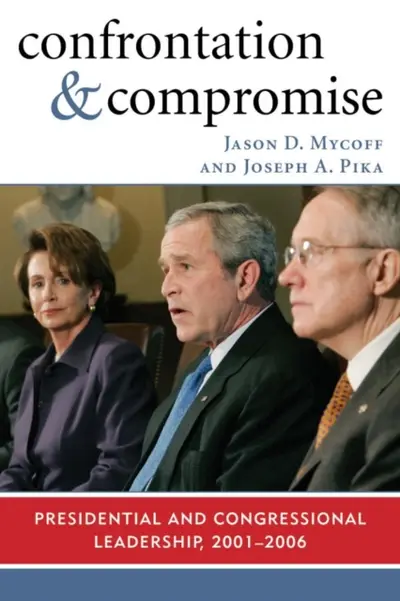
Confrontation and Compromise
Presidential and Congressional Leadership, 2001-2006
Price and availability
$51.99
Available in: Andorra, Austria, Australia, Belgium, Bulgaria, Canada, Switzerland, Cyprus, Czechia, Germany, Denmark, Estonia, Spain, Finland, France, United Kingdom, Guernsey, Greece, Croatia, Hungary, Ireland, Isle of Man, Iceland, Italy, Jersey, Japan, Liechtenstein, Lithuania, Luxembourg, Latvia, Monaco, Malta, Netherlands, Norway, Poland, Portugal, Romania, Sweden, Slovenia, Slovakia, San Marino, United States, Vatican City, South Africa
Stores: US, UK, Canada, EU, Australia.
Sign in to buyThe price is re-checked by the server before payment.
For personal use under the eBook licence.
- Format
- DRM
- Not stated by the publisher
- Language
- English
- Publisher
- Bloomsbury Publishing (USA)
- Published
- 10 July 2007
- Pages
- 282
- ISBN
- 9780742574809
- Subjects
- USA, c 2000 to c 2010, History of the Americas, 21st century history: from c 2000 -, Political structure & processes, Political leaders & leadership, United States of America, USA, 3MRBA, Political structure and processes, Political leaders and leadership, NH, NHK
About this book
The authors examine the relationship between President George W. Bush and the U.S. Congress to explore political leadership in American politics. Six case studies make clear that individual leaders in both the Congress and the administration provide the direction, coherence, and energy that leadership requires. Two case studies concentrate on solutions devised to resolve long-standing policy issues that had been the center of controversy even before Bush's election: education reform and campaign finance reform. Two cases focus on issues that arose in the aftermath of 9/11: intelligence reform and creation of the Department of Homeland Security. Two are drawn from Bush's second term: the response to Hurricane Katrina and the failed effort to reform Social Security. The authors draw several general conclusions. Direction, coherence and energy are provided by multiple national leaders, not just by the president. Like other presidents, Bush sought to dominate national policy-making but ultimately found it necessary to effect tactical and policy reversals, actions inconsistent with his image as an uncompromising man of principle. Legislative success often depended on the skills of Bush's allies and particularly on the efforts of bipartisan and sometimes bicameral "e;tandems"e; who forged compromises across party and institutional lines that made progress possible.
Bibliographic data © Gardners Books Ltd.