PDF · English
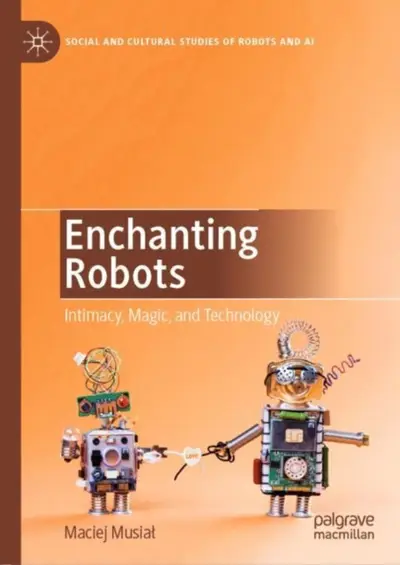
Enchanting Robots
Intimacy, Magic, and Technology
Price and availability
$107.99
Available in: Andorra, Austria, Australia, Belgium, Bulgaria, Canada, Switzerland, Cyprus, Czechia, Germany, Denmark, Estonia, Spain, Finland, France, United Kingdom, Guernsey, Greece, Croatia, Hungary, Ireland, Isle of Man, Iceland, Italy, Jersey, Japan, Liechtenstein, Lithuania, Luxembourg, Latvia, Monaco, Malta, Netherlands, Norway, Poland, Portugal, Romania, Sweden, Slovenia, Slovakia, San Marino, United States, Vatican City, South Africa
Stores: US, UK, Canada, EU, Australia.
Sign in to buyThe price is re-checked by the server before payment.
For personal use under the eBook licence.
- Format
- DRM
- Not stated by the publisher
- Language
- English
- Publisher
- Springer International Publishing
- Published
- 28 February 2019
- ISBN
- 9783030125790
- Subjects
- Society & culture: general, Child & developmental psychology, Cognition & cognitive psychology, Electrical engineering, Automatic control engineering, Artificial intelligence, Society and culture: general, Child, developmental and lifespan psychology, Cognition and cognitive psychology, Automatic control engineering, Artificial intelligence (AI)
About this book
This book argues that robots are enchanting humans (as potential intimate partners), because humans are enchanting robots (by performing magical thinking), and that these processes are a part of a significant re-enchantment of the "e;modern"e; world. As a foundation, the author examines arguments for and against intimate relationships with robots, particularly sex robots and care robots. Moreover, the book provides a consideration of human-robot interactions and philosophical reflections about robots through the lens of magic and magical thinking as well as theoretical and practical re-evaluations of their status and presence. Furthermore, the author discusses the abovementioned issues in the context of disenchantment and re-enchantment of the world, characterizing modernity as a coexistence of these two processes. The book closes with a consideration of future scenarios regarding the meaning of life in the age of rampant automation and the possibility that designing robots becomes a sortof new eugenics as a consequence of recognizing robots as persons.
Bibliographic data © Gardners Books Ltd.