PDF · English
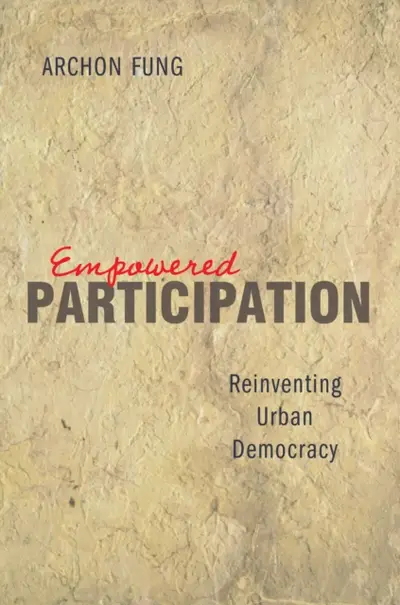
Empowered Participation
Reinventing Urban Democracy
Price and availability
$56.99
Available in: Andorra, Austria, Australia, Belgium, Bulgaria, Canada, Switzerland, Cyprus, Czechia, Germany, Denmark, Estonia, Spain, Finland, France, United Kingdom, Guernsey, Greece, Croatia, Hungary, Ireland, Isle of Man, Iceland, Italy, Jersey, Japan, Liechtenstein, Lithuania, Luxembourg, Latvia, Monaco, Malta, Netherlands, Norway, Poland, Portugal, Romania, Sweden, Slovenia, Slovakia, San Marino, United States, Vatican City, South Africa
Stores: US, UK, Canada, EU, Australia.
Sign in to buyThe price is re-checked by the server before payment.
For personal use under the eBook licence.
- Format
- DRM
- Not stated by the publisher
- Language
- English
- Publisher
- Princeton University Press
- Published
- 10 January 2009
- ISBN
- 9781400835638
- Subjects
- Illinois, Social issues & processes, Urban communities, Politics & government, Public administration, Regional government, United States of America, USA, Politics and government, Regional, state and other local government
About this book
Every month in every neighborhood in Chicago, residents, teachers, school principals, and police officers gather to deliberate about how to improve their schools and make their streets safer. Residents of poor neighborhoods participate as much or more as those from wealthy ones. All voices are heard. Since the meetings began more than a dozen years ago, they have led not only to safer streets but also to surprising improvements in the city's schools. Chicago's police department and school system have become democratic urban institutions unlike any others in America. Empowered Participation is the compelling chronicle of this unprecedented transformation. It is the first comprehensive empirical analysis of the ways in which participatory democracy can be used to effect social change. Using city-wide data and six neighborhood case studies, the book explores how determined Chicago residents, police officers, teachers, and community groups worked to banish crime and transform a failing city school system into a model for educational reform. The author's conclusion: Properly designed and implemented institutions of participatory democratic governance can spark citizen involvement that in turn generates innovative problem-solving and public action. Their participation makes organizations more fair and effective. Though the book focuses on Chicago's municipal agencies, its lessons are applicable to many American cities. Its findings will prove useful not only in the fields of education and law enforcement, but also to sectors as diverse as environmental regulation, social service provision, and workforce development.
Bibliographic data © Gardners Books Ltd.