PDF · English
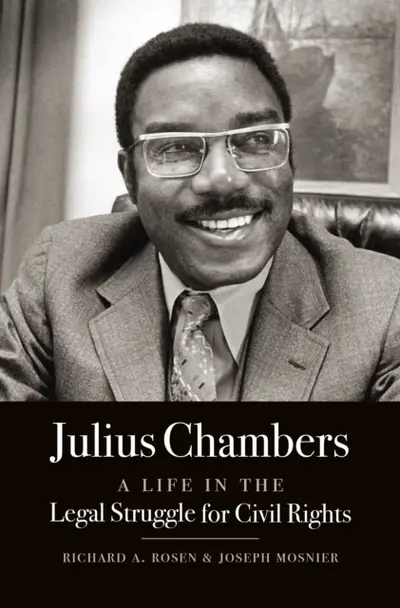
Julius Chambers
A Life in the Legal Struggle for Civil Rights
Price and availability
$32.99
Available in: Andorra, Austria, Australia, Belgium, Bulgaria, Canada, Switzerland, Cyprus, Czechia, Germany, Denmark, Estonia, Spain, Finland, France, United Kingdom, Guernsey, Greece, Croatia, Hungary, Ireland, Isle of Man, Iceland, Italy, Jersey, Japan, Liechtenstein, Lithuania, Luxembourg, Latvia, Monaco, Malta, Netherlands, Norway, Poland, Portugal, Romania, Sweden, Slovenia, Slovakia, San Marino, United States, Vatican City, South Africa
Stores: US, UK, Canada, EU, Australia.
Sign in to buyThe price is re-checked by the server before payment.
For personal use under the eBook licence.
- Format
- DRM
- Not stated by the publisher
- Language
- English
- Publisher
- The University of North Carolina Press
- Published
- 18 October 2016
- Pages
- 408
- ISBN
- 9781469628554
- Subjects
- USA, c 1945 to c 2000 (Post-war period), Biography: historical, political & military, Black & Asian studies, Civil rights & citizenship, United States of America, USA, 3MPQ, DNBH, JBSL, JPVC
About this book
Born in the hamlet of Mount Gilead, North Carolina, Julius Chambers (19362013) escaped the fetters of the Jim Crow South to emerge in the 1960s and 1970s as the nation's leading African American civil rights attorney. Following passage of the Civil Rights Act of 1964, Chambers worked to advance the NAACP Legal Defense Fund's strategic litigation campaign for civil rights, ultimately winning landmark school and employment desegregation cases at the U.S. Supreme Court. Undaunted by the dynamiting of his home and the arson that destroyed the offices of his small integrated law practice, Chambers pushed federal civil rights law to its highwater mark.In this biography, Richard A. Rosen and Joseph Mosnier connect the details of Chambers's life to the wider struggle to secure racial equality through the development of modern civil rights law. Tracing his path from a dilapidated black elementary school to counsel's lectern at the Supreme Court and beyond, they reveal Chambers's singular influence on the evolution of federal civil rights law after 1964.
Bibliographic data © Gardners Books Ltd.