PDF · English
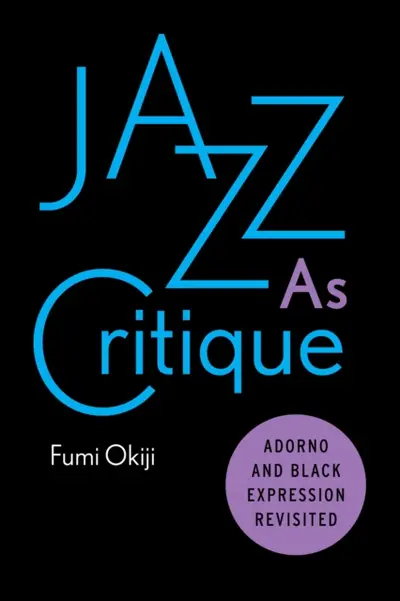
Jazz As Critique
Adorno and Black Expression Revisited
Price and availability
$21.99
Available in: Andorra, Austria, Australia, Belgium, Bulgaria, Canada, Switzerland, Cyprus, Czechia, Germany, Denmark, Estonia, Spain, Finland, France, United Kingdom, Guernsey, Greece, Croatia, Hungary, Ireland, Isle of Man, Iceland, Italy, Jersey, Japan, Liechtenstein, Lithuania, Luxembourg, Latvia, Monaco, Malta, Netherlands, Norway, Poland, Portugal, Romania, Sweden, Slovenia, Slovakia, San Marino, United States, Vatican City, South Africa
Stores: US, UK, Canada, EU, Australia.
Sign in to buyThe price is re-checked by the server before payment.
For personal use under the eBook licence.
- Format
- DRM
- Not stated by the publisher
- Language
- English
- Publisher
- Stanford University Press
- Published
- 4 September 2018
- ISBN
- 9781503605862
- Subjects
- Theory of music & musicology, Jazz, Social & political philosophy, Theory of music and musicology
About this book
This "e;lucidly argued, historically grounded . . . and timely book"e; reexamines the relationship between black cultures, jazz music, and critical theory (Alexander G. Weheliye, Northwestern University). A sustained engagement with the work of Theodor Adorno, Jazz As Critique looks to jazz for ways of understanding the inadequacies of contemporary life. While Adorno's writings on jazz are notoriously dismissive, he has faith in the critical potential of some musical traditions. Music, he suggests, can provide insight into the controlling, destructive nature of modern society while offering a glimpse of more empathetic and less violent ways of being together in the world. Taking Adorno down a new path, Okiji calls attention to an alternative sociality made manifest in jazz. In response to writing that tends to portray it as a mirror of American individualism and democracy, she makes the case for jazz as a model of "e;gathering in difference."e; Noting that this mode of subjectivity emerged in response to the distinctive history of black America, she reveals that the music cannot but call the integrity of the world into question.
Bibliographic data © Gardners Books Ltd.